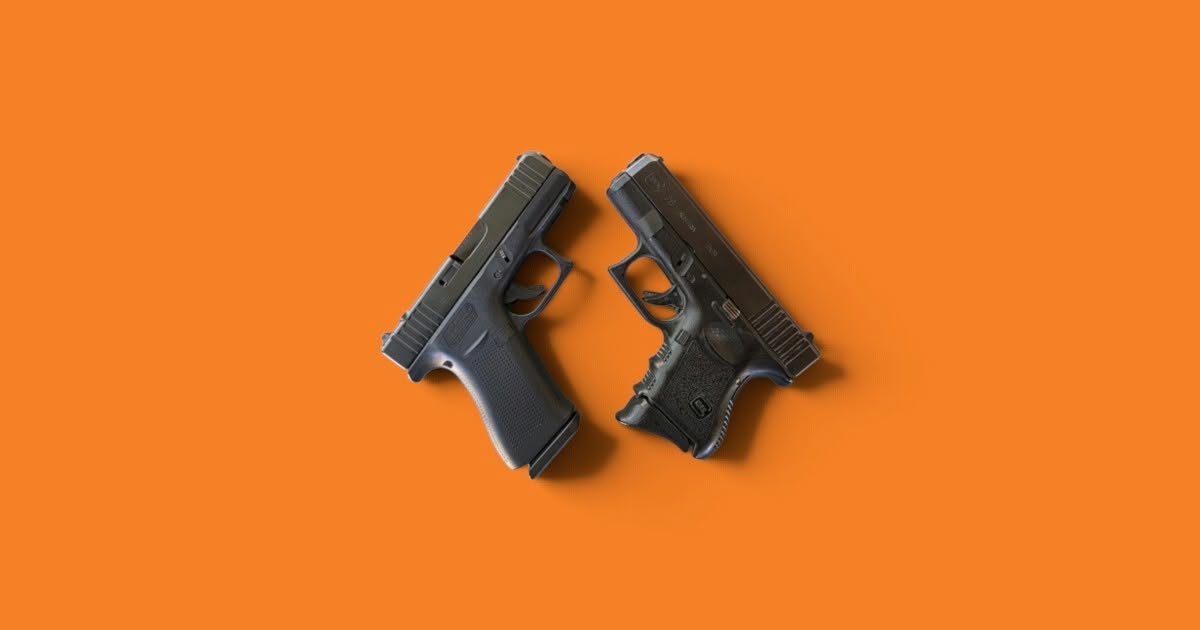
Article: Is the Glock 19 Really the Minimum for Concealed Carry?
Is the Glock 19 Really the Minimum for Concealed Carry?
You Don't Get to Pick the Answer Before You Define the Problem
The Glock 19 is an excellent default for concealed carry. That doesn't make it a universal minimum. Define the requirements first: who you're hiding the gun from, what you're wearing, what you're doing while carrying it, how well you need it concealed, whether you can properly access it and how well you can actually shoot it. Exhaust the variables you can change before giving up capability in the gun. If the gun itself still has to change, give up only what the problem requires.
There is a particular kind of argument that shows up almost every time somebody talks about carrying a small handgun.
Anything smaller than a Glock 19 is inadequate. If you can't conceal a Glock 19, dress around the gun. Printing doesn't matter. If the gun is uncomfortable, suck it up. If you can't get away with carrying enough gun, you're doing something wrong.
I agree with some of the sentiment behind those statements. I think a lot of people make excuses for carrying less gun than they could. There are people who could carry a Glock 19 all day, every day, comfortably and effectively concealed, but don't because doing so requires a little more thought about clothing, a better belt, a better holster, some experimentation with placement, or simply accepting that carrying a serious handgun isn't always going to be completely comfortable.
Convenience is not the same thing as necessity. If you can carry and properly access a more capable handgun without violating the actual concealment requirement, I'm generally not going to argue that you should carry less gun simply because the smaller one is easier.
But sometimes the constraint is real, and once it is, telling somebody to "just carry a bigger gun" stops being useful advice.
The Glock 19 Is a Really Good Answer
There's a reason the Glock 19 became something close to the Goldilocks handgun. It's big enough to shoot well, small enough to conceal reasonably well, holds a useful amount of ammunition, gives most people enough grip to properly control the gun, and accommodates modern optics and lights. More broadly, the compact service-pistol size class represented by the G19 has proven itself across an enormous range of civilian and professional applications.
For a very large percentage of people, in a very large percentage of circumstances, something around that size probably is close to the sweet spot. I have no problem with the Glock 19 being the default. Defaults are useful because they give us a sensible place to start.
And I understand why people turn that default into a hard rule. If you tell people every carry decision is completely individual, some percentage of them will use that flexibility to rationalize whatever is easiest. The G19 rule prevents that by establishing a floor: start with a serious, proven compact handgun and don't move below it just because something smaller is more comfortable.
That's not stupid advice. As a default, I think it's good advice. The problem starts when a useful default gets promoted into a universal requirement and we stop allowing actual circumstances to challenge it.
A default says, "Start here unless the facts give us a reason to move." A minimum says, "Anything below here is unacceptable regardless of the facts." I can defend the first statement easily. I have a much harder time defending the second.
What exactly does "the Glock 19 is the minimum" mean? Minimum ammunition capacity? Barrel length? Grip length? Grip circumference? Practical accuracy? Shootability? Ballistic performance? Performance on a particular drill?
If we're going to call something a minimum, there ought to be some measurable performance requirement underneath it. Otherwise "minimum" isn't actually a standard. It's a preference expressed using the vocabulary of a standard.
I don't think the answer is swapping one universal standard for another. A useful minimum has to describe what a particular person and complete carry system need to be capable of doing, under the conditions in which that system will actually be used. Whether that can be reduced to a universal standard is a much bigger question. The physical dimensions of one particular handgun aren't a performance standard.
That's where I think this conversation starts to go sideways.
Put the Same Gun on Somebody Else
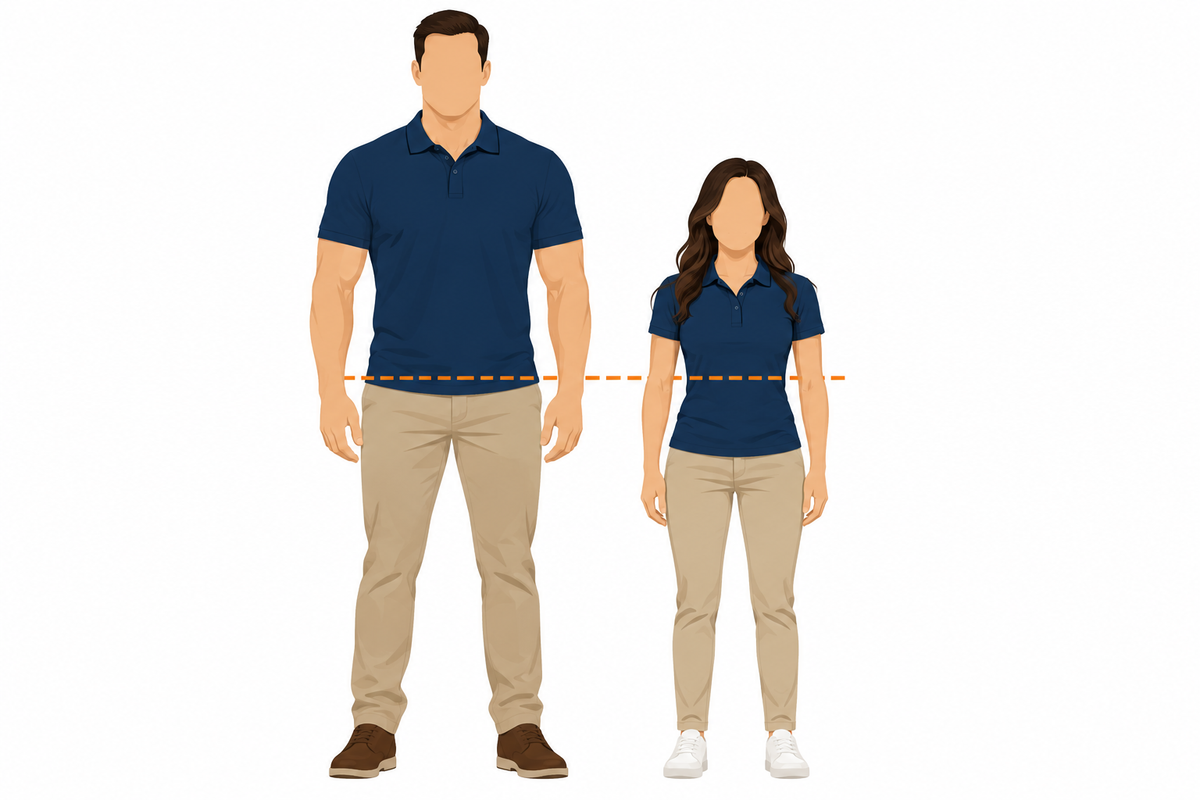
I'm 6'4" and about 225 pounds. There are things I can hide on my body that a 5'2", 105-pound woman simply cannot hide the same way. That's not training, commitment or mindset. It's geometry.
Take something as mundane as a Best Buy uniform. Could I conceal a Glock 19 under one of those blue polos? Probably. Put the same polo on a 5'2", 105-pound woman and we have a different problem.
The gun didn't change. The dress code didn't change. The requirement that nobody realizes you're carrying didn't change. The available space in which we have to make all of this work changed substantially.
Even height and weight don't tell us everything. Two people can be exactly the same height and weight and have substantially different torso lengths, waist circumferences, chest-to-waist differentials, pelvic structures, abdominal contours, body-fat distribution and places where clothing naturally hangs away from the body.
A firearm has fixed geometry. Human beings don't.
So when somebody says, "I can conceal a Glock 19 under a T-shirt," that's useful information about that person and that T-shirt. It doesn't establish a universal minimum handgun size. The useful question is whether this particular person can conceal it under these particular clothes, doing these particular things, for this many hours, to the required standard of concealment, while still being able to properly access the gun.
Nobody Has to See the Gun
People telegraph that they're carrying in ways that have nothing to do with the outline of a gun through a shirt. They bend differently. They protect one side of their body. They pull their shirt down every time they stand up. They touch the gun through the cover garment. They readjust the holster after getting out of the car. They squat awkwardly to pick something up because bending normally would expose the gun. They unconsciously check the position of their shirt throughout the day.
None of those behaviors means anything by itself. Together, they can tell an observant person you're armed.
Maybe the observer never sees the grip. Maybe there isn't a recognizable outline through the shirt. The observer simply watches you move through the world and concludes that you're protecting, accommodating or repeatedly checking something at your waistline.
At that point, the gun itself was concealed. The fact that you were armed wasn't.
This also means "concealed" can't be treated as a simple YES/NO condition. There's the gun itself: obviously visible, recognizably printing, ambiguously printing, or invisible while you're standing and obvious when you bend or reach. There's the carrier's behavior, which can reveal that they're armed even when the gun stays hidden. And there's the observer: concealment that survives a casual glance may not survive eight hours next to coworkers, or somebody who knows what to look for.
Those are different kinds of failure, and "easy to conceal" doesn't tell you which one somebody means.
Now Go to Work
Imagine somebody working behind the counter at an electronics store. They're wearing an employer-prescribed polo, bending over displays, reaching across counters and interacting with customers a few feet away all day.

Now consider an IT technician crawling under desks, climbing ladders, reaching overhead and squeezing behind equipment.

Or a waiter wearing a tucked white shirt and apron, constantly bending and reaching while customers sit at almost exactly waist level.

Or somebody working in a nursery or retail environment, lifting boxes, squatting and carrying things.

Or a medical professional wearing scrubs, bending, lifting and working in close physical proximity to other people for twelve hours at a time.

None of these people are conducting covert operations in some exotic location. That's precisely why they're useful examples.
We have a tendency in the gun world to assume that unusually demanding concealment requirements only exist in unusually dangerous or exotic environments. They don't. A person's threat environment and the difficulty of their concealment problem are separate variables. Someone can have an entirely mundane threat environment and an extremely demanding concealment requirement. Someone else can be operating in a legitimately dangerous environment and have a relatively easy concealment problem because he's wearing a jacket.
"Printing Doesn't Matter"
Sometimes it doesn't. If you're walking through Home Depot in Houston on Saturday morning wearing jeans and an untucked shirt, somebody briefly noticing a weird corner underneath your shirt may have essentially no consequence.
Now change the setting or the circumstances. What if discovery gets you fired? What if it gets you removed from an assignment? What if it compromises an investigation? What if it reveals something to a person who specifically cannot know you're armed? "Nah, nobody notices printing anyway" isn't much of an answer to any of those problems.
If you're an off-duty cop, the consequences of somebody noticing your gun are very different from those faced by most people. It might create an uncomfortable ten seconds that ends when you pull out your badge. For somebody else, the same discovery could cost them their job.
The same distortion can happen inside the firearms industry and the world immediately adjacent to it. A lot of us live in a completely artificial little bubble and eventually forget that it's artificial. You go to work wearing jeans and an untucked T-shirt or hoodie. Your coworkers carry guns. Your boss carries a gun. Your customers carry guns. Somebody buys a new pistol and shows it around the office. At lunch, three guys walk into the parking lot because somebody has a new AR in his truck.
In that world, who gives a shit if somebody notices the corner of your Glock through your shirt?
And I'm probably a pretty shitty person to use as the universal model for this myself. I'm 6'4", 225 pounds, I've spent more than twenty years designing holsters, I work in the firearms industry, I can dress however the hell I want most days, and virtually everyone I work around knows I'm a gun guy. If I built my definition of "reasonable concealment" entirely around my own life, I'd be committing almost every error I'm describing in this article.
That environment can also convince you that you're better concealed than you actually are. If everyone around you knows you're carrying, assumes you're carrying, or doesn't care, nobody reacts to your concealment failures, and you read the absence of a reaction as evidence that there weren't any.
Put that same person somewhere nobody expects him to be armed, where he spends eight hours in close proximity to the same coworkers day after day and discovery actually carries consequences, and suddenly we're testing something very different. The guy saying "printing doesn't matter" may be completely right about his life. He may also be considerably less concealed than he thinks he is.
Experience can become misleading when we try to turn it into a prescription for somebody else. What clothing choices were available? What level of concealment was required? What kinds of movement were involved? How much close physical proximity was typical? What happened if the gun was detected? Those conditions determine what the person's experience actually demonstrates.
Experience gives us information. It doesn't repeal geometry.
And No, This Isn't an Excuse for Laziness
People absolutely use concealment as an excuse for convenience. "I don't want to change the way I dress" is not the same thing as "I cannot change the way I dress." Likewise, "I prefer carrying a smaller gun" is different from "my circumstances require a smaller gun."
Sometimes the constraint is preference. Sometimes it's self-imposed. Sometimes somebody is simply unwilling to tolerate a little inconvenience. If your entire concealment problem could be solved by buying a shirt that fits differently, and there is no meaningful reason you can't do that, perhaps the answer isn't a smaller gun.
Maybe you should buy the fucking shirt.
Or maybe the answer isn't another gun, another holster, another belt or another shirt at all. Maybe it's finding a tailor and having some of the clothes you already own altered. But that's a much less satisfying answer than having a box of new gear delivered to your house on Thursday.
"Suits my needs" isn't an answer. Neither is "fits my use case." They're where the explanation starts. What's the need? What does it require that the bigger gun can't deliver? What did you try changing first? What did you give up, and what did you get in exchange? If you can't answer those questions, you haven't identified a constraint. You've identified a preference.
Going to a smaller gun is very often the easy button. Reduce the dimensions of the thing you're trying to hide and, unsurprisingly, it gets easier to hide. But that doesn't mean you've actually solved the problem. It may just mean you skipped most of the work.
But if your employer determines the shirt, your work determines the movements you have to perform, your anatomy determines how much room there is to work with, and the consequences of getting caught determine how well the gun has to disappear, we're talking about actual constraints.
There is a big difference between refusing to make an accommodation and reaching the point where another accommodation simply creates a larger problem somewhere else.
Accessibility Isn't Yes/No Either
Suppose somebody can conceal a Glock 19, but meeting the required concealment standard means the gun has to ride unusually deep. They can get their fingertips onto the grip, but nothing anywhere close to a full firing grip before beginning to draw the gun from the holster.
Now give the same person a smaller handgun. Because there is less gun to hide, we may be able to move it higher while maintaining the same level of concealment and give the carrier the ability to achieve a full firing grip before the gun begins moving out of the holster.
Which of those solutions leaves the person more effectively armed?
That's a different question from simply asking which handgun is better. The larger handgun may be easier to shoot. It may hold more ammunition, provide better recoil control, accept a larger weapon light and give the shooter more surface area to control. Those are legitimate advantages, but you don't get any of them until the gun is in your hand.
"But Can They Actually Shoot the Smaller Gun?"
Shooting performance has to be part of this too, but we make the same mistake when we assume that a gun that's generally easier to shoot is therefore easier for every individual to shoot.
Smaller handguns generally demand more from the shooter. There is less gripping surface, recoil management can be more difficult, manipulations less forgiving, and practical accuracy and speed can suffer. If somebody cannot operate a particular handgun to an acceptable standard, the fact that they can hide it beautifully doesn't make it the correct gun.
But what if they can? More specifically, what if they actually shoot the smaller gun better?
Take our 5'2", 105-pound woman again. What if the dimensions of her hands and the geometry of her grip mean she shoots a Glock 43, 43X or 48 better than a Glock 19?
Hand size, finger length, trigger reach, grip circumference and the person's ability to establish and maintain control all affect what that shooter can actually do with the gun. "The G19 is easier to shoot" may be a useful generalization across a population. It doesn't tell us whether this particular human being shoots it better. That's something we can test.
Maybe the person shoots the G19 better, but concealing it requires carrying it so deeply that their initial purchase is compromised, while the smaller gun can be positioned higher and accessed cleanly. Now we're weighing one advantage against another.
Or maybe the person conceals the G43X better, accesses it better and shoots it better. What exactly are we compromising at that point?
A gun doesn't become more capable because the spec sheet says it should be. The capability we're interested in is what this particular person can actually extract from it.
You Were Already Compromising
The language around "compromising" by carrying a smaller handgun gets a little silly. Of course it's a compromise. So is carrying a Glock 19.
And if maximum weapon capability is really the governing principle, why stop there? Why not a FLUX Raider, an MP5, or a Mk18? Why exactly did we decide that the Glock 19 is the point at which further compromises suddenly become unacceptable?
Every person who chooses a handgun has already accepted an enormous reduction in weapon capability in exchange for portability and concealability. We've given up stability, effective range, ballistic performance and multiple points of contact with the weapon. We accept all of that because walking around with a Mk18 under your shirt presents some fairly obvious practical problems.
So the argument was never really about whether weapon capability should be compromised for concealability and portability. We agreed to that the moment we selected a handgun. The argument is where the compromise should occur.
The G19 is itself the product of a set of compromises that happen to work extraordinarily well for a lot of people. A smaller handgun may sacrifice capacity, gripping surface or shootability in exchange for reduced dimensions. A larger handgun carried deeply may sacrifice initial access in exchange for better shootability once it's out. Higher ride height can improve access while exposing more of the gun above the belt. Lower ride height can improve concealment while reducing the amount of grip available before extraction.
There isn't an uncompromised concealed weapon. There are different compromises, and the fact that your preferred compromise involves carrying more gun doesn't automatically make it the correct one.
Everybody wants everything: more gun, more concealment, faster access, more comfort. I also want a Suburban that runs a ten-second quarter mile, gets 45 miles per gallon, tows 18,000 pounds, handles like a Porsche 911, rides like a Mercedes S-Class, and costs $29,000. At some point physics gets involved.
So the question isn't "How much gun can I possibly stuff into my waistband?" Nor is it "What's the smallest gun I can get away with?" The useful question is what combination gives this person the most capability without violating the requirement that made them carry concealed in the first place.
The Gun Isn't the System
A Glock 19 isn't a concealed-carry system. Neither is a Glock 43. Neither is the holster.
The system is the person, gun, holster, belt or other support structure, placement, ride height, clothing, environment and everything that person has to physically do while carrying it. That includes whether the system allows them to move naturally or forces them to start unconsciously accommodating the gun.
Change the person, clothes, activity, placement or concealment requirement and you can change the answer.
That's why I don't think there is any meaningful way to describe a handgun as simply "concealable." Concealable by whom, wearing what, doing what, and to what standard?
The industry makes it very easy to forget this. Manufacturers, retailers, reviewers and instructors all deal in hardware because hardware can go on a spec sheet, be photographed, compared and sold. Nobody can sell you the interaction between your anatomy, clothing, movement and required level of concealment. There's no Buy Now button for it.
I design and sell holsters for a living, so I'm part of that incentive structure. Sometimes the right answer really is a different gun or holster. But buying more hardware is also a very easy way to feel like you've done something without ever figuring out why the last system failed.
Your Mirror Is Lying to You
People put the gun on, stand in front of the bathroom mirror for thirty seconds, turn left, turn right, maybe take a picture, and decide they've solved concealment.
That's not how people live.
Carry the gun for ten hours. Drive for two. Eat lunch. Sit in an office chair. Stand up twenty times. Bend over. Tie your shoe. Pick something off the floor. Climb stairs. Get into a truck. Get out of it. Use a bathroom. Reach onto a shelf. Do all of that without constantly touching the gun, adjusting the holster, pulling your shirt down or moving your belt around. Now we know something.
A mirror can tell you what the gun looks like while you're standing still and deliberately looking for it. It can't tell you whether carrying that gun changes how you move six hours later.
I'm not arguing that concealed carry needs to be luxurious. It's a gun strapped to your body. But a system that's uncomfortable enough that you're constantly managing it creates another problem: all of that draws more attention than the gun itself.
"Those Are Edge Cases"
Okay. Let's talk about edge cases.
Roughly one in ten people is left-handed. A large 2020 meta-analysis estimated the prevalence of left-handedness at about 10.6% of the population. Serious holster product lines routinely accommodate left-handed users through dedicated left-hand SKUs or ambidextrous designs.
Nobody looks at a left-handed customer and says, "Sorry, you're an edge case. Learn to shoot right-handed."
Handedness obviously isn't a perfect analogy. It's essentially fixed, while some concealment constraints can be changed. But once we've identified a constraint that can't be changed, the underlying design problem starts looking very similar.
We don't design a right-handed holster, discover that it doesn't work for a left-handed person, and conclude that the left-handed person is doing holsters wrong. We recognize that the user changed, so the solution has to change. Why would we suddenly abandon that logic when the variable is anatomy instead of handedness?
If a particular solution works beautifully for most people and poorly for some portion of the population, the correct conclusion isn't that those people are wrong. It means we found the boundary of that solution. And frankly, those boundaries are usually where you learn the most.
When the "Minimum" Becomes Nothing
There's another problem with declaring the Glock 19 the minimum acceptable handgun: what happens when somebody legitimately can't make that minimum work?
If anatomy, clothing, occupation or concealment requirements prevent somebody from carrying a G19-sized handgun without creating some other unacceptable problem, maybe they can carry a G43X. Maybe they can carry a G43. Maybe they can carry something else.
But if our position is that anything below the G19 is inadequate, we've reduced their choices to two: carry the G19 anyway and fail the requirement, or carry nothing. At that point we have to ask a question that tends to get skipped in these arguments: is nothing actually the better answer?
Maybe sometimes it is. I'm not arguing that carrying any gun is automatically preferable to carrying no gun. If somebody can't safely and competently operate a particular handgun, handing them a smaller one doesn't magically solve the problem. But if they can competently operate the smaller gun, access it properly, conceal it to the standard their circumstances require, and will actually carry it consistently, declaring that gun unacceptable doesn't somehow put a Glock 19 on their body. It may leave them with nothing.
And now the comparison isn't really Glock 19 versus Glock 43 anymore. The Glock 19 has already failed one of the requirements. The actual comparison may be Glock 43 versus nothing. If we're going to insist that nothing is the better answer, we should at least be able to articulate why.
So What Should You Carry?
Start with as much useful capability as you can preserve and then make the compromises the actual problem requires.
Before you start giving up capability in the gun, work the variables you can change. Clothing. Belt. Placement. Holster. Ride height. Training. If changing those solves the problem without creating a larger one somewhere else, you're done. Only when you've exhausted those variables and the system still can't meet the requirement should you start asking whether the gun itself needs to get smaller.
And even then, don't just ask whether you need "a smaller gun." Identify what about the current gun is actually preventing the system from working. Grip length? Slide thickness? Grip circumference? The relationship between ride height and how much gun has to remain below the belt? If the problem is thickness, that's a different fix than if it's grip length. Change the thing that's causing the problem and test the complete system again.
If you can carry a Glock 17 effectively concealed, access it properly, shoot it well and live with it through everything you actually do, then that's what you should carry. There's no reason to carry less gun just for the sake of carrying less gun. If the G19 gets you there with fewer penalties, great. If the G26 allows you to meet a concealment requirement the G19 doesn't while still giving you a gun you shoot extremely well, then the G26 may be the better answer for that person. Same with the G43, G43X or G48.
And if you actually perform better with one of those smaller guns than you do with the G19, we shouldn't have to invent a reason to call that a compromise just because the gun is smaller.
The smaller gun shouldn't get a free pass because it's convenient, any more than the larger gun should get a free pass because it's theoretically more capable. Every compromise should have to justify itself.
That logic runs in both directions. Some of the people insisting that the Glock 19 is the minimum may find, if they apply the same standard honestly to themselves, that they should be carrying a bigger gun. If your body, clothing and daily environment allow you to conceal a Glock 17 just as effectively, you can access it just as well and you shoot it better, what exactly is the Glock 19 buying you? You've given up two rounds and grip length for concealability you didn't need.
Some of the people feeling particularly righteous about carrying a G19 are making the same kind of unnecessary compromise they accuse the guy carrying the G43 of making. They just drew the line immediately underneath the gun they already carry.
Sometimes the answer will be changing guns. Sometimes it'll be everything else. And sometimes, yes, the answer is that the person complaining that they "can't" conceal a Glock 19 really needs to buy a better holster, put on a different shirt and stop being soft.
That's different from pretending everybody has the option.
Define the Problem First
Defining the problem means being able to answer some basic questions:
- Who are you actually hiding the gun from, and for how long?
- What are you going to be wearing?
- What do you have to do while wearing it?
- What happens if somebody realizes you're armed?
- Can you get a proper grip before the gun starts moving out of the holster?
- Can you actually shoot the gun to the standard you require?
- Which parts of the system can you reasonably change, and which ones are actually fixed?
Once you've identified a constraint that can't reasonably be changed, accept what it tells you. Neither "carry more gun" nor "carry less gun" is doctrine. The point is to test the entire system against the problem it's supposed to solve and make sure the compromises you've made aren't unnecessarily handicapping your ability to defend yourself.
If you finish this article thinking I've told you to carry a smaller gun, I've failed to make the point. I don't know what gun you should carry because I don't know your problem. Nobody else does either, and you won't until you've defined it.
Before we start arguing about the answer, we should probably make sure we're solving the same problem.
Source
Handedness prevalence: Papadatou-Pastou M, et al. Human handedness: A meta-analysis. Psychological Bulletin (2020).