Article: Glock 26 vs. 43X/48 vs. G19: What Does “Performs Better” Actually Mean?
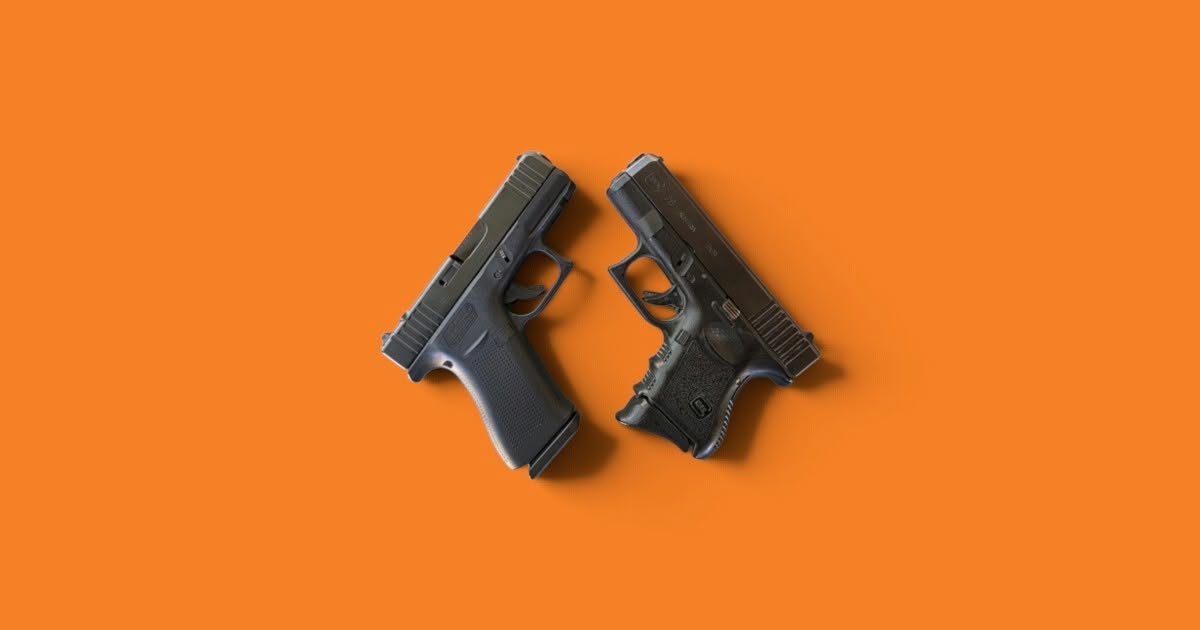
Glock 26 vs. 43X/48 vs. G19: What Does “Performs Better” Actually Mean?
On Friday, September 18, I posted something on Instagram about why I keep coming back to the Glock 26. Predictably, people had opinions.
Most of the discussion eventually settled around three basic choices: the G26, the 43X/48, and the G19. Mike Pannone at CTT Solutions made the case for the 43X/48 based on the frankly staggering amount of ammo he's spent shooting and comparing these guns. My friend Paul at TASKER came at it from the other direction: if I'm willing to carry that much gun, why not just carry a G19?
That's a better question than it initially appears. I can tell you which of these guns is thinner. I can tell you which has the longer grip, which holds more ammunition, and I can put them on a timer and tell you which one I shoot faster. None of that, by itself, tells me which one I should carry.

Start With the Body
If I were optimizing strictly for concealment, I wouldn't carry a G26 OR a 43X. I'd probably carry a G42. If I were optimizing strictly for shooting, I'd skip all of them and carry a G17 or G34.
But I don't do either of those things. Concealed carry happens somewhere between those two extremes, and the closer you look at everything that happens between them, the messier the decision gets.
Start with the human body. That's the one part of the system you don't get to choose. It has its own dimensions, proportions and geometry. So do the hands attached to it.
Now start stacking variables onto it. Pick a gun. Put it in a holster. Attach that holster to a belt. Decide where around the waist you're going to carry it. Set ride height and cant. Then cover the whole thing with whatever clothes you're going to wear. None of those variables exists independently of the others. Change one and you can change the importance of several others.
Take the width of the gun, for example. I completely understand why a thinner 43X or 48 could make a significant difference for someone. But in my current setup, it doesn't.
My Ares Gear Aegis belt is so stiff that, carrying AIWB, there is no detectable difference in the bulge at my waistline between a G48 and a G19. The G19 is objectively thicker, but the belt is stiff enough that the extra width basically smushes into my gut rather than bending the belt outward around it. So in my particular pants + belt + holster + gun combination, that additional thickness simply doesn't translate to a meaningful difference in concealment.
Switch me to a thinner dress belt and maybe it does. Switch the G19 for a G20 and eventually I'm sure we'll find the point where thickness starts to matter. But with the equipment I'm actually wearing and the guns we're actually discussing, it's basically a wash.
For me.
Put the same guns on somebody with a different body, belt, holster, clothing or carry position and you may get a completely different result.
Where the Gun Is Big Matters
Now look at grip length.
The G26 I normally carry has a Pearce pinky extension. That makes the frontstrap roughly as long as the 43X/G19, but the heel is still considerably shorter.
But grip length isn't really one measurement. The Pearce extension gives me somewhere to put my pinky without extending the backstrap and heel to the same point as the longer-framed guns. Mike and Paul both treated these as roughly the same grip length in the original discussion, but geometrically they aren't. Carrying AIWB, that shorter heel matters to me because that's frequently the part of the gun I'm actually fighting to conceal.
Move the exact same gun to my strong side and put it in a holster with a really aggressive forward cant, though, and something interesting happens. Now I've rotated that long frontstrap and pinky extension outward, and that front corner can become the part I'm fighting to keep from printing. The gun didn't change. Where I put it did, and that changed which dimension mattered.
There are also times when I'll put a flush magazine in the G26 under certain sport coats. Now the whole grip gets shorter, which is great for concealment. Except I just gave up a full firing grip and some control of the gun while shooting to get it.
What did I gain? What did it cost me to get it?
Your Hands Are Part of the System
The same thing happens with hands. I have big hands, and the wider G26 grip fits them better. But even saying "big hands" is almost useless. Big palms with short, thick fingers aren't the same thing as big palms with long, thin fingers. Finger length, thickness, joint placement and palm width all change where your hand lands on the gun and how well you can operate it. Someone else's hands may make the 43X a substantially better gun for them.
And the same person's answer can change over time.
For years my daily carry was a G34 with a TLR-1, AIWB, with the frame chopped to G19 length. And I mean daily carry. My build, the clothes I wore, my belt, and where my pants sat relative to my anatomical waist let me comfortably carry a frankly ridiculous amount of gun below the belt.
That was 12–15 years ago. My once-washboard abs have since acquired some table muscle, and I'm buying pants with a different waist size these days. Same guy, different body, different answer. Even my own answer isn't permanent because the system I'm trying to fit the gun into isn't permanent.
But there's another clue buried in that old G34 that I think is even more important.
I chopped the frame.
I didn't shorten the slide. I shortened the grip.
I'd happily carry a G17 with the grip chopped to G26 length. I'd happily carry a compensated G19 with the grip chopped to G26 length. Give me the longer slide, barrel, additional reciprocating mass or a compensator if those things improve how the gun shoots. None of that particularly bothers me if I can comfortably conceal it.
The dimension I'm much less willing to accept when I don't need it is additional grip length above the belt. That's the dimension I keep paying for.
So What Does the 43X Give Me?
Mike has shot these guns enough that I'm not particularly interested in arguing with his observations about how they perform on the range. I'm more interested in what those observations tell us about selecting a concealed-carry gun.
My original question in the Instagram comments was simple: What does the 43X give me that the G26 doesn't?
There are legitimate answers. The longer grip can make it easier to establish a firing grip and potentially give you a stronger firing grip once you have it. It can make reloads easier. The slimmer grip may fit your hands better. And compared to the G19, the 43X/48 is thinner and lighter.
The capacity calculation has also changed. Glock's new factory magazine for the 43X/48 is a 15-round metal double-stack design, so the old 10-round-versus-15-round comparison with the G19 no longer applies. That's a meaningful improvement to the 43X/48 proposition.
But look at what the 43X/48 is fundamentally doing geometrically. It reduces width while retaining a relatively long grip.
For somebody whose body, clothing or carry system makes width expensive, that's a very attractive trade. My current setup makes width relatively cheap. Grip length, particularly at the heel, is expensive.
So Mike and I don't necessarily have to disagree about what either gun does. We can agree on the dimensions. We can agree on what happens on the timer. We can agree that the 43X/48 does certain things better. We can still arrive at different answers because those characteristics don't cost us the same thing.
Which G26 Are We Comparing?
The comparison gets even messier once we start modifying the guns. A compensator can make a significant difference in how these guns shoot. Mike has specifically talked about the performance of a comped 43X.
Fine. If the 43X gets a comp, the G26 gets one too.
The G26 also has this weird tendency to get compared in whichever configuration makes it look worst for the particular point being discussed. When concealment is the issue, we're comparing the 43X to my G26 with the pinky extension because that makes the front of the grips roughly the same length. When we're talking about getting a full firing grip, suddenly we're talking about the G26 with the flush magazine.
Well, which G26 are we comparing?
I can run it flush when maximum concealment matters. I can put the pinky extension on it when I want a fuller firing grip. I can put a larger magazine in it. I can compensate it if that's part of the comparison. That configurability is itself one of the things I value about the gun. My requirements aren't necessarily the same every time I get dressed.
Compare factory guns to factory guns, or modified guns to modified guns. If we're optimizing the 43X/48 with aftermarket parts, the G26 gets to come to the party too.
What Does “Shoots Better” Mean?
A shot timer can tell us extremely useful things. It can tell us which gun we draw faster, which one we shoot faster, and which one produces better hits on a particular drill. Those are real measurements, and they matter.
But the timer can't tell me whether another half-inch of grip prints under my sport coat, whether another quarter-inch of width creates a visible bulge with my belt, whether the lining of my jacket is going to hang up on the heel of the gun, or how the thing feels after I've been sitting in a car for three hours. More importantly, the timer can't tell me how much I should value any of those things relative to whatever difference it measured on the range.
Some of those variables are harder to put a number on. That doesn't make them less real.
Even "shoots better" starts getting slippery if you push on it hard enough. Imagine two guns of roughly the same size and equal reliability. One is mechanically capable of only mediocre practical accuracy, but its design lets you shoot it incredibly fast. The other is capable of almost surgical precision, but its design makes it considerably slower to shoot.
Which one shoots better? Which one would YOU choose?
Some people will take the accurate gun every time. Others will take the faster gun as long as its accuracy is good enough for what they're asking it to do. Change the distance, the size of the acceptable hit zone, the difficulty of the shot or the amount of time available, and you may change somebody's answer.
Or you may not.
The Human First
RCS has approached this problem from the carrier's side of the equation for more than twenty years. The gun has dimensions. So does the human carrying it.
The same thinking applies to damn near every other piece of concealed-carry equipment. Take belt attachments.
People will argue that a metal overhook is "better" than a polymer overhook because it's harder to pull off the belt. Okay. If maximum attachment security is the overriding requirement, why are we using an overhook at all? Use a solid loop that the belt has to pass through.
Of course, now you've made the holster considerably less convenient to put on and take off. Maximum security may be important enough to you that the inconvenience is worth it. For somebody else, frequent donning and doffing may make the overhook a better solution.
Performance is the relationship between what the equipment is and what you're asking it to do.
What Does the G19 Give Me?
Paul's question still needs an answer. If I'm willing to carry this much gun, why not just carry the G19?
What does the G19 give me that my G26 doesn't?
More ammunition in the gun and a longer grip that may make it easier to access and shoot. In exchange, I have to permanently accept the longer heel.
The G26 makes a different trade. Run flush, I give up capacity for a substantially more compact grip. Because it takes full-size Glock magazines, I can put a longer one in whenever I want the grip and the capacity back, or carry one as my reload.
I already know which dimension costs me more. My belt makes width cheap. The heel isn't.
That's why I'd happily carry a G17 chopped to G26 grip length, or a compensated G19 chopped the same way. I'm perfectly willing to carry more gun in dimensions that are cheap for me.
I want less gun where more gun is expensive.