Article: I Can't Give My Son September 10th
I Can't Give My Son September 10th
Twenty-five years ago tonight, the World Trade Center was still standing.
Nearly 3,000 people who would be dead before the end of the following day were still alive. They were eating dinner, putting their kids to bed, finishing a shift, packing for a trip, watching Monday Night Football, setting an alarm for work the next morning. Maybe arguing with their spouse about something that seemed important at the time. It was Monday, September 10th, 2001. It was an ordinary day, and nobody knew it was the last day of America-that-was.
Tomorrow, as we have every year for the last quarter-century, we will see the images from September 11th. The towers burning. Smoke pouring across Lower Manhattan. People covered in grey dust running through the streets. Images that remain burned into the memories of those of us who watched that day unfold in real time. For those of us who remember, those images still carry tremendous weight. We don't need anyone to explain why. We remember what it felt like to watch them.
But twenty-five years later, there is something we need to recognize: there are now adults who don't remember September 11th. They know about it. That's different.
Some weren't born yet. Others were babies or small children. They have lived their entire conscious lives in the America that came afterward. The changes that still feel like changes to those of us who remember September 10th are simply the world they've always known.
Every September, we tell them to "Never Forget." But you can't remember something you never knew. We can show a 22-year-old the most horrifying footage from September 11th a thousand times. He can understand that thousands of innocent people died. He can comprehend the scale of the destruction and understand why those images still affect people who lived through it. What he cannot see in those images is what disappeared.
He never knew the baseline.
If we expect younger Americans to understand the sense of loss that people of our generation still feel when September rolls around, showing them increasingly shocking images of September 11th isn't enough. They know what happened on September 11th. What they don't know is what the world looked and felt like on September 10th.
And I think it's important to distinguish that from the usual nostalgia about how much the world has changed since we were young. Of course it has. Every generation watches the world change. That's not what I'm talking about.
My grandfather was born in 1915. My dad was born in 1941. I was born in 1977. Think about how radically America changed across those three lives. My grandfather came of age before World War II. My dad came of age around 1960. I came of age in the 1990s. The culture changed. The technology changed. The country changed.
But some surprisingly fundamental parts of ordinary American life remained recognizable across all three of our lived experiences.
None of us spent our lives continuously in the eye of security cameras. None of us carried a tracking device on our body everywhere we went. Most of the places we went and things we did simply disappeared into yesterday rather than becoming part of some permanent, searchable record.
Even getting on an airplane was still pretty simple. By the time I was flying, there were metal detectors and baggage screening, but flying wasn't significantly different from taking a train or going to see a movie: buy a ticket and go to your seat. Someone who wasn't flying could walk all the way to the gate with you. That was normal.
And yet, despite those 62 years between us, when it came to some pretty fundamental assumptions about individual liberty, privacy, anonymity, public access and the freedom to simply move through the world, my grandfather and I lived on the same side of a line my son was born on the other side of. What's strange is that my own life straddles that line almost perfectly. The first half of it was spent in a world much closer to my grandfather's. The second half will be spent in one much closer to my son's.
That's what makes this different from the usual complaint that ‘the world has changed since I was young.’ That baseline survived enormous changes in American life across three generations of my family, and then changed dramatically within my own adult lifetime.
I wasn't a kid on September 10th, 2001. I was 24 years old. The America I'm talking about isn't some hazy childhood memory where everything seemed freer because I didn't know any better. I lived in that America as an adult.
I remember what public spaces felt like. I remember a time before the TSA, before the Department of Homeland Security, before the PATRIOT Act, before "See Something, Say Something" became part of the American vocabulary. More than anything, I remember when being left alone still felt like the default.
And I mean "default" literally. Privacy was largely passive. You didn't have to work particularly hard to create it because most of ordinary life simply wasn't being recorded in the first place. Today, maintaining any meaningful degree of privacy requires active effort. You have to opt out, turn things off, deny permissions, avoid certain services and deliberately limit the information you leave behind. Privacy used to be something you gave up by letting people in. Now it's something you have to fight to keep them out. And increasingly, the fact that you're fighting to keep it makes people wonder what you're hiding.
The world I knew died on September 11th.
My son will never know that world, and that's a strange thing to realize as a father. I can show him photographs. I can tell him stories. I can try to explain what America felt like before September 11th.
But I can't give him September 10th.
He won't remember government buildings and installations before the barriers, bollards, concrete and ever-expanding security perimeters because he'll assume they've always looked like that. The language after September 11th was about protecting Americans. But one of the most visible changes was how much better the apparatus of government became at protecting itself from Americans. If you could grab an American adult on September 10th, 2001 and drop him into 2026, I think the physical security surrounding government facilities would be one of the first clues that something fundamental had changed in the relationship between the citizen and the state.
The physical barriers are only part of the world my son will inherit. He'll grow up surrounded by cameras and automated license-plate readers that record where people and vehicles travel. Facial recognition can search enormous databases of human faces. Artificial intelligence can turn oceans of information into something searchable and actionable in seconds. None of this will strike him as remarkable. It'll simply be part of the furniture of his world.
The relationship between Big Tech and Big Government may be even harder to explain to someone from September 10th. Government surveillance existed in 2001, and corporations collected information about their customers. What would have seemed almost unthinkable was the scale of both and the increasingly incestuous relationship between them. Technology companies can know extraordinary amounts about where we go, what we search for, what we buy, who we communicate with, what we read and what we watch. Government can seek access to privately collected information, purchase commercial data and rely on private companies for capabilities that increasingly blur the line between corporate data collection and government surveillance. That should make people uncomfortable regardless of which political party controls the government.
On September 10th, 2001, the idea that someday we'd voluntarily carry a device in our pocket that continuously generated information about where we went, what we searched for, what we bought and who we communicated with would have sounded like science fiction.
Today we call it a phone.
I'm not arguing that every camera is evil or every security measure is unnecessary. If someone steals my truck, I'll be pretty damn happy if a license-plate reader helps the police find it. But "this technology can be used to do something good" is a pretty shitty standard for deciding how much surveillance power anyone should have.
September 11th didn't create this technology. What it changed was the bargain Americans were willing to make between liberty and security. Technology spent the next twenty-five years making the consequences of that bargain vastly larger than anyone standing there on September 10th could possibly have imagined.
Some of those changes were necessary. Most were not. And plenty of what we were told was temporary turned out to be anything but. Very little went away. It became part of the landscape, and eventually we stopped being shocked by it. We used to argue about where the line should be. I'm increasingly concerned that we've forgotten there was supposed to be a line.
That's the part I keep coming back to when I think about my son. He was born into the America that came after. He won't experience the checkpoints, cameras, databases and security barriers as things that happened to America. They'll simply be America. Things that would have seemed extraordinary to my grandfather, my father and me will be so ordinary to him that he'll have no reason to question when they arrived or whether they were always there.
Someday I'll show my son the images from September 11th. He'll understand that people died. He'll understand that it was horrible. He'll understand why we remember them. What will be much harder to explain is why those images hurt people of my generation in a way they can never hurt him.
Because when I look at those images, I'm not only seeing what happened that morning.
I'm watching the world I knew disappear.
My son is still a child, but an entire generation with the same disconnect is already here. There are NYPD officers and FDNY firefighters and paramedics serving New York City today who weren't even alive on September 11th. There are soldiers, sailors, airmen and Marines risking their lives for this country who were born after the attacks that would shape so much of the world they eventually volunteered to serve in.
They know what happened. Of course they do. Some of them serve in institutions that carry September 11th as part of their own history. But they never knew the baseline. They know September 11th through photographs, video, books and stories told by people older than them.
And that's not their failure. It's ours if we don't bother to tell them what September 10th was.
That's why September 10th matters to me.
September 11th already has a purpose. It's the day we remember the people we lost. Nearly 3,000 human beings woke up on an ordinary Tuesday morning, got dressed, kissed someone goodbye, and headed off to start their day expecting to be home later. They weren't. Their families lost husbands and wives, mothers and fathers, sons and daughters, brothers and sisters and friends. There were empty chairs at dinner tables that night that would remain empty forever. Nothing else needs to be attached to that loss to make September 11th worth remembering.
But I think September 10th should have a purpose too.
September 11th is when we remember the people we lost. September 10th should be when we remember everything else we lost.
The freedoms. The privacy. The distance that once existed between private life and government scrutiny. The expectation that extraordinary government powers granted during an emergency would actually remain extraordinary. And maybe most importantly, the simple assumption that you could go about an ordinary day without constantly leaving behind a permanent, searchable record of it.
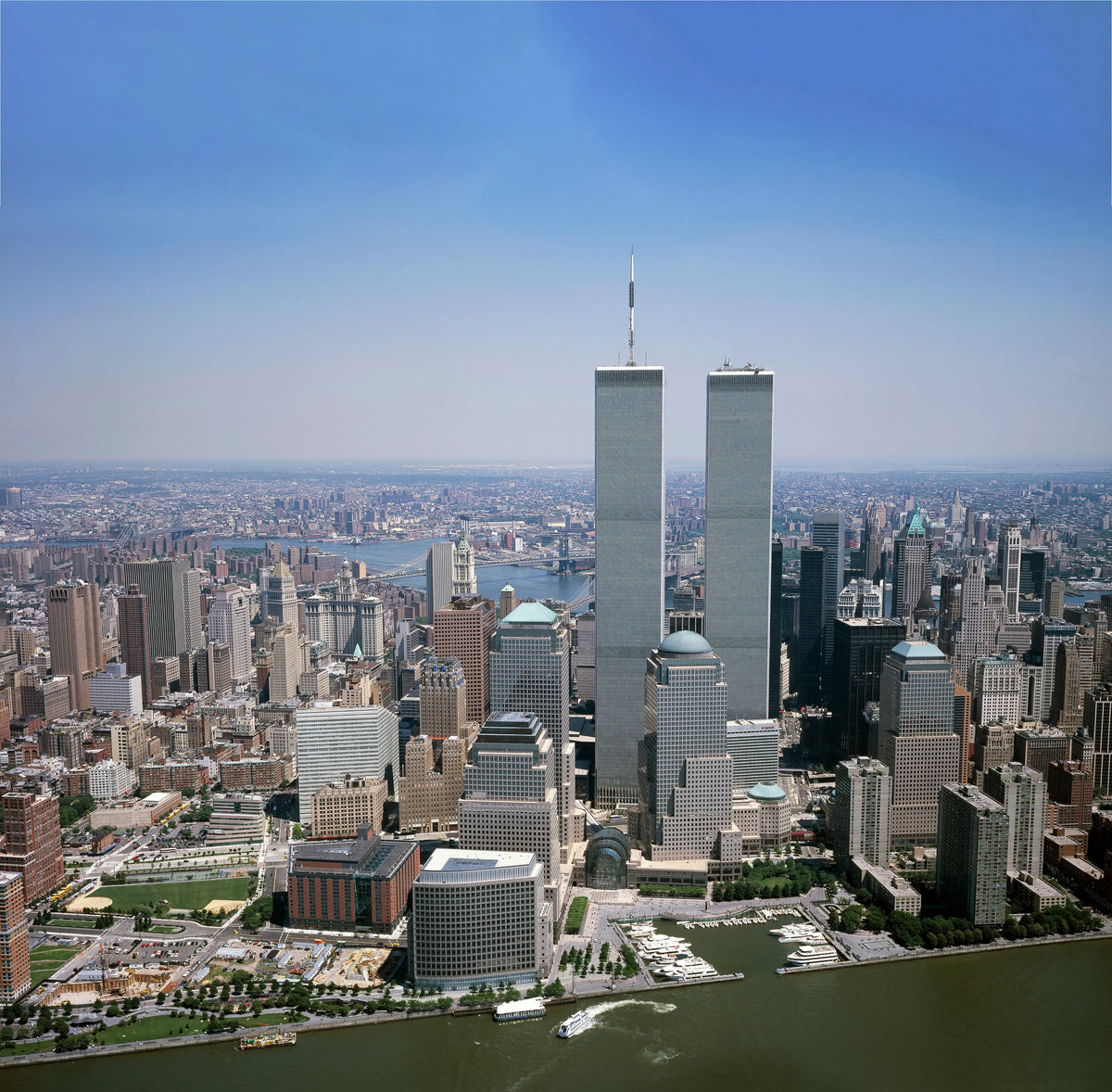
There is something haunting about an ordinary photograph of Manhattan taken before September 11th. Not the photographs of smoke and fire we've all seen a thousand times. Just an ordinary photograph of the skyline. The towers are there, enormous and completely unremarkable. People are working inside them. Cabs are moving through traffic below. Someone is late for a meeting. Someone is pissed off at a customer. Someone is wondering what to have for dinner. Someone keeps looking at the clock because they want to get home to their kids.
Nobody in that photograph knows they're looking at something that is about to disappear. And I'm not just talking about the buildings.
That's the part that gets me now. Nobody knew they were living through the last ordinary day. Nobody knew to look at the skyline one more time, appreciate how casually they moved through an airport, or notice all the cameras that weren't there. Nobody knew that our relationship with privacy, security, government and even the simple idea of being left alone was about to change. Most of us had never thought much about any of it. It was just how life worked. And nearly 3,000 people didn't know they were going to wake up the next morning and never come home.
You don't know you're living in the "before" until the "after" arrives.
September 10th, 2001 was just a Monday. For me, it was the last Monday of the America I knew. And eventually, those of us who remember that America won't be here at all.
That's why I think "Never Forget" needs to mean something more after twenty-five years. The generations coming behind us know what happened on September 11th. We have spent a quarter-century showing them. What they don't know is what isn't in those pictures.
So tomorrow, remember the people we lost. Remember the people who went to work and never came home, the families who waited for phone calls that never came, the empty chairs and all the lives that continued afterward with someone permanently missing from them. That's what September 11th is for.
But today is September 10th.
Remember the skyline intact. Remember when privacy was the default, not something you had to actively create and defend. Remember the freedoms we hadn't yet been asked to trade for security and the things we didn't even know we were about to lose. And while there are still enough of us around who actually remember that world, tell the people who don't.
They can't fully understand what happened on September 11th without understanding what we had on September 10th.
Tomorrow, remember who we lost. Today, remember everything else.