
Copia Pistol
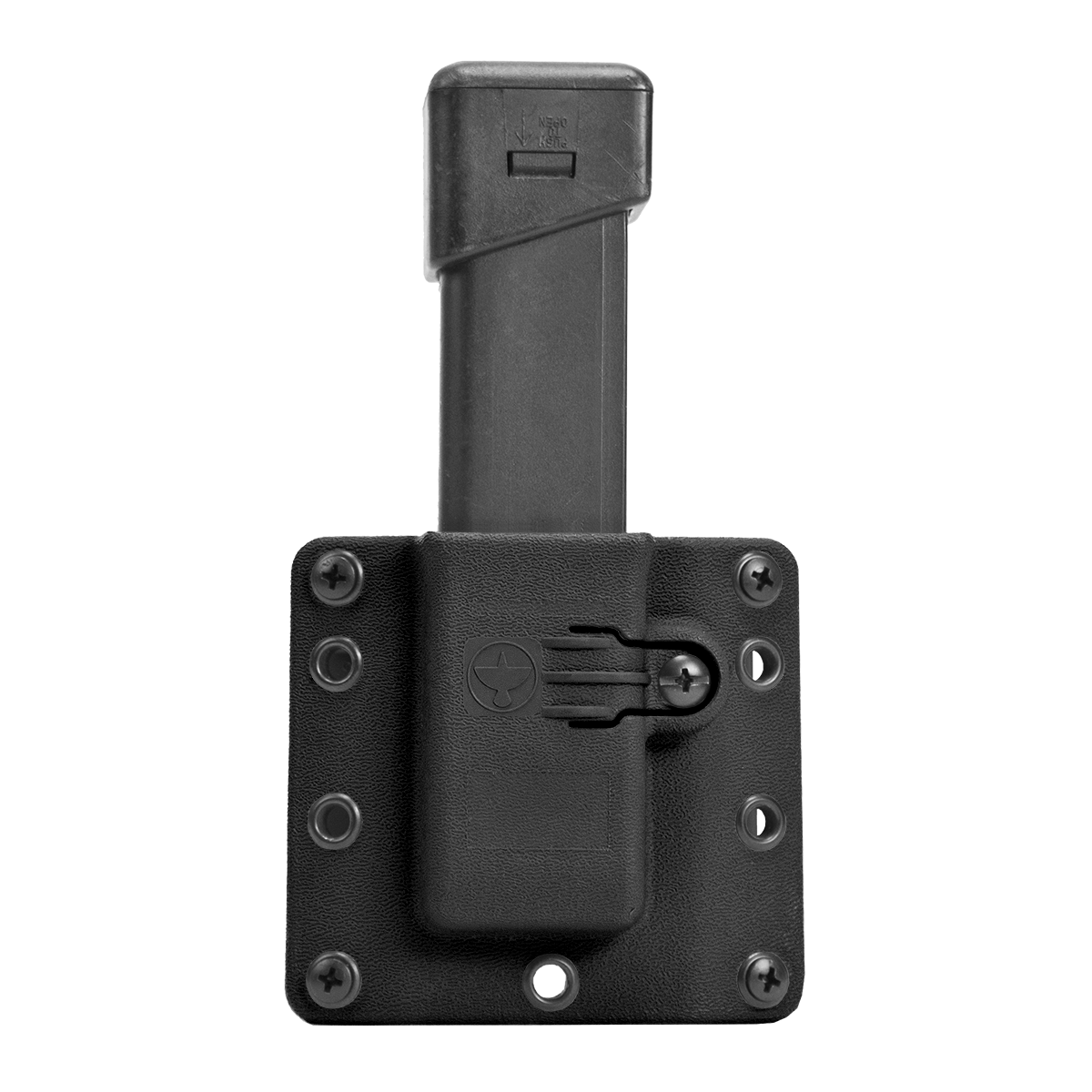
Copia Pistol Magazine Carrier
You may own many pistols. You only need one carrier.
Made in USA | Unconditional lifetime warranty | Developed to fulfill a government contract requirement
Quick Scan
| Feature | Detail |
|---|---|
| Product | Copia Pistol Magazine Carrier |
| Configuration | Single or Double (factory riveted) | Singles linkable via separate hardware kit |
| Compatible With | Double-stack pistol magazines — steel and polymer — 9mm / .40 / .357 SIG |
| Fitments | Glock, Sig Sauer, Beretta, FN, HK, Walther, Springfield, Smith & Wesson, CZ, and 100+ additional models |
| Orientation | Ambidextrous — magazine seats forward or rearward facing |
| Body Variants | Short (reduced profile) | Tall (full attachment compatibility) |
| Retention | Adjustable — independent per magazine on double configuration |
| Belt Compatibility | Uses the same attachment system as the Phantom holster — standard OWB loops included; compatible with all Phantom-pattern attachments including pancake wings, QMS, tuckable overhooks, and IWB soft loops (purchased separately) |
| Drop/Offset Kit | Compatible with Phantom/Phantom LC drop/offset kit (sold separately) |
| Configurable | Single units linkable into double or larger configurations via hardware kit; factory doubles available |
| Made in USA | Yes |
| Lifetime Warranty | Yes — unconditional, follows the product |
The Standard
The Copia pistol magazine carrier was built for the problem that arises when an organization issues two different pistols and needs one carrier that handles both.
A Glock 17 and a Sig P229 do not share a magazine.
The conventional answer has been to spec a carrier to one platform and require everyone to conform.
The Copia is a different answer.
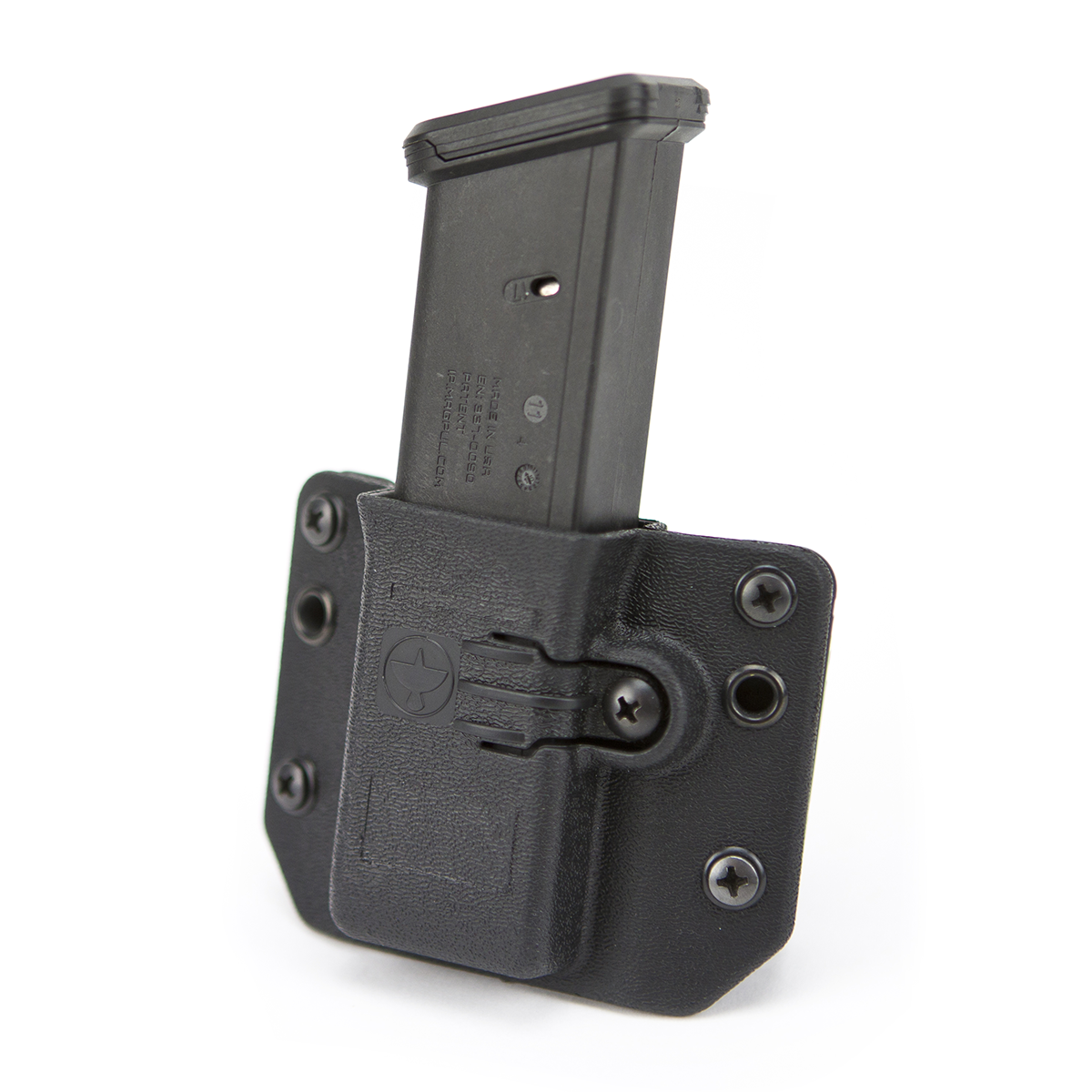
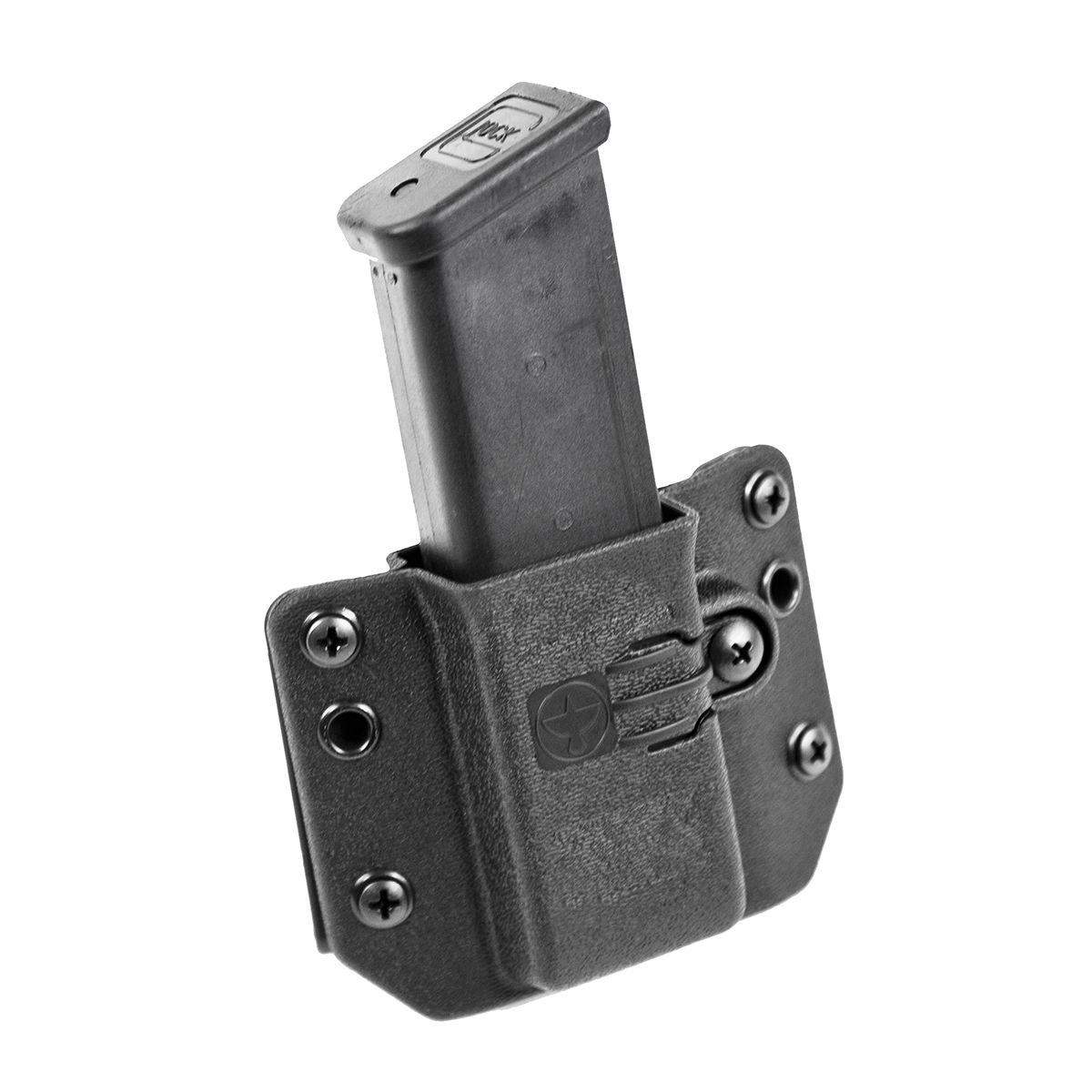
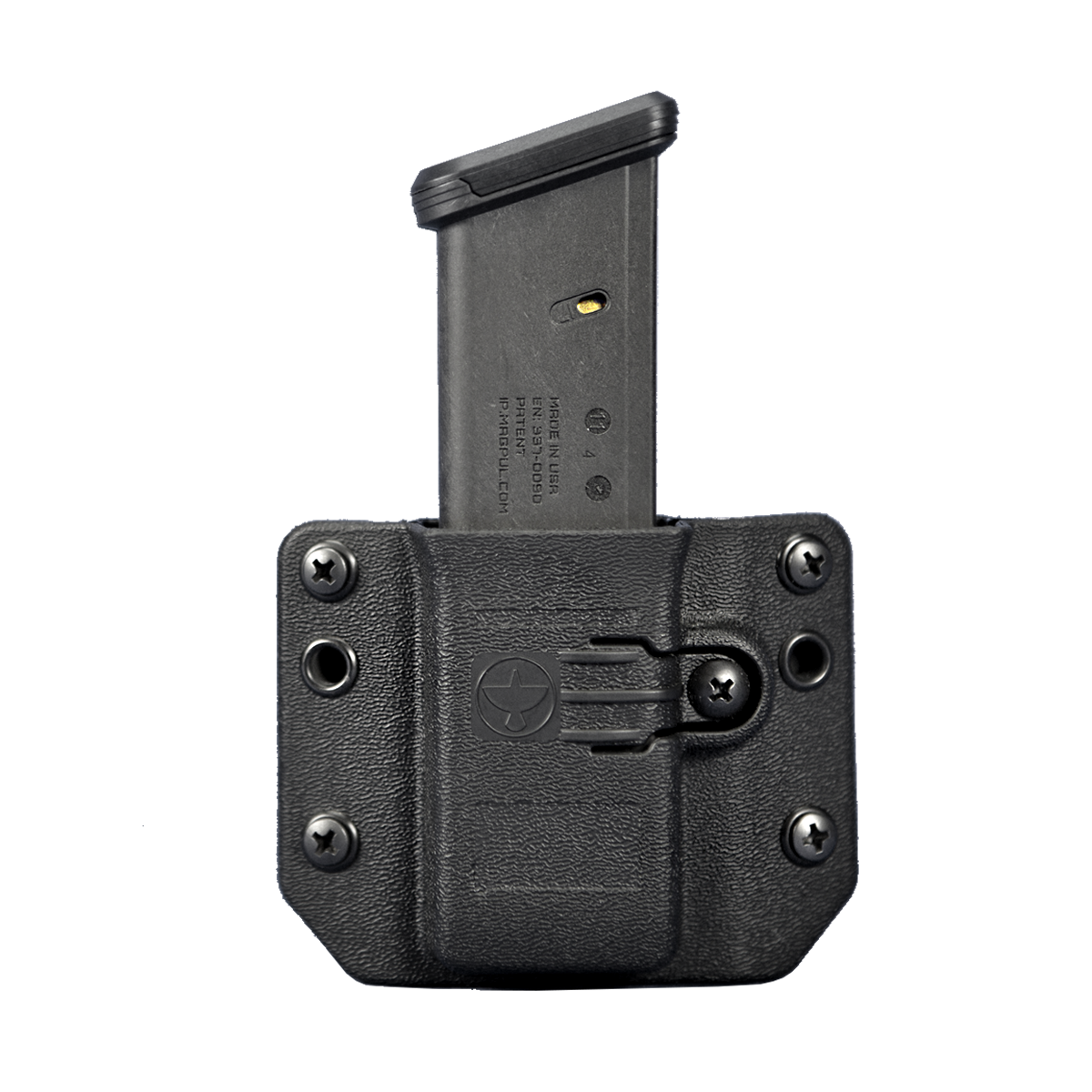
Developed to fulfill a government contract requirement, the Copia's origin was specific: an agency juggling personnel issued Sig P229s alongside contractors issued Glock 19s needed an ambidextrous magazine carrier that would accept magazines from both platforms without modification, without per-unit tuning, and without stocking two separate carrier SKUs. The Copia's adjustable cavity geometry accommodates double-stack steel and polymer magazines chambered in 9mm, .40, and .357 SIG across more than 100 different pistol models. Retention is adjustable. The magazine seats forward or rearward facing in the same carrier body.
The Copia does not ask you to standardize your magazine platform to fit your carrier.
Injection molded for maximum functionality and durability, the Copia holds its retention geometry, resists the chemical environment of regular gun maintenance, and does not degrade under the daily mechanical stress of a carrier that is loaded and unloaded in regular use. Consistency across units is a byproduct of the process — the primary reason is that injection molding produces a better carrier.
For more than two decades, Raven Concealment Systems has focused on a single problem: solving the concealment and carry equation at the highest professional level. The Copia is that philosophy applied to the question of what comes after the first magazine.
Good gear disappears from behavior.
What Makes a Pistol Magazine Carrier Work
| Requirement | Why it matters |
|---|---|
| Multi-platform magazine compatibility | A carrier spec'd to one platform forces the organization to change carriers every time the issued pistol changes — or stock a separate SKU for every platform carried simultaneously. |
| Adjustable retention across magazine body types | Steel and polymer magazines have different dimensional tolerances; fixed-retention carriers tune for one and absorb whatever degradation that imposes on the other. |
| Magazine seats forward or rearward in the same body | Fixed insertion orientation forces the user to adapt their setup to the carrier; selectable orientation lets the carrier conform to the setup already in place. |
| Consistent retention unit to unit | Inconsistent production tolerances require per-unit tuning at the point of issuance — a logistical cost that compounds at scale. |
| Modular belt attachment compatibility | A carrier locked to a proprietary attachment system cannot integrate into an existing modular rig without displacing hardware already in use. |
| Low-profile body geometry | Cross-section against the body determines whether the carrier disappears under a cover garment or announces itself through it. |
| Scalable single-to-double configuration | An organization that needs single-mag and double-mag configurations for different assignments should not have to stock two different carrier bodies to cover both. |
The Copia pistol magazine carrier was built around those requirements from the beginning.
The Magazine Carrier Compromise
Every magazine carrier that accepts multiple platforms makes a tradeoff. The engineering decision that allows a single body to accept a Glock 17 magazine and an FN 509 magazine is the same decision that prevents that body from being dimensionally optimized for either one.
That tradeoff is real. The Copia does not pretend otherwise.
What the Copia does is optimize around it. The adjustable retention system allows the carrier to be calibrated to the specific magazine being carried, rather than set to a fixed tolerance that splits the difference across platforms and serves none of them fully. The magazine seats forward or rearward facing, letting the user configure draw stroke geometry to their actual setup rather than adapting their setup to the carrier. The flared mouth makes seating the magazine an administrative task that does not require looking at the carrier — a practical necessity for users who carry the Copia at a belt position that is not in their direct sightline.
What the user gains is something a dedicated single-platform carrier cannot offer: a carrier that remains fully functional across platform transitions, training rotations, and multi-pistol operations without requiring a new piece of equipment each time. The precision gap is real and the Copia does not close all of it — but adjustable retention closes most of it, and the rest of the distance is covered by a carrier that works the first time across every platform in the approved armory.
For organizations, the implications compound. A single carrier SKU that covers the full armory means one part number to procure, one item to stock, one piece of equipment to train against, and one less variable when personnel transition between assignments or platforms change. Equipment fragmentation has a cost that does not appear on any individual purchase order — it appears in logistics, in training hours, in issuance errors, and in the organizational friction of managing multiple carrier specs for a population that may be carrying different pistols on the same team. The Copia is the answer to that problem before it starts.
Versatility is not the absence of precision. It is precision applied to a larger problem.
Dedicated vs. Multi-Platform: What the Choice Actually Means
A dedicated single-platform carrier offers one thing a multi-platform carrier cannot: a cavity machined to the exact dimensional profile of one magazine body. That precision is real, and for a user who will carry exactly one pistol for the foreseeable future, it is a legitimate reason to choose a dedicated carrier.
A multi-platform carrier offers something a dedicated carrier structurally cannot: the ability to work across issued platforms, training platforms, and platform transitions without requiring the user or the organization to re-spec the carrier each time. For users who carry more than one pistol, or belong to an organization that fields more than one, that capability is not a convenience — it is a logistical requirement.
The Copia's adjustable retention closes most of the precision gap. It does not close all of it. What it does is give the user direct control over retention calibration rather than inheriting a manufacturer's fixed assumption about the middle of the distribution. For most users carrying most double-stack magazines in 9mm, .40, or .357 SIG, the calibrated Copia holds as well as a dedicated carrier in practical use.
The correct choice depends on one question: how many pistol platforms do you actually need the carrier to support?
The Profile
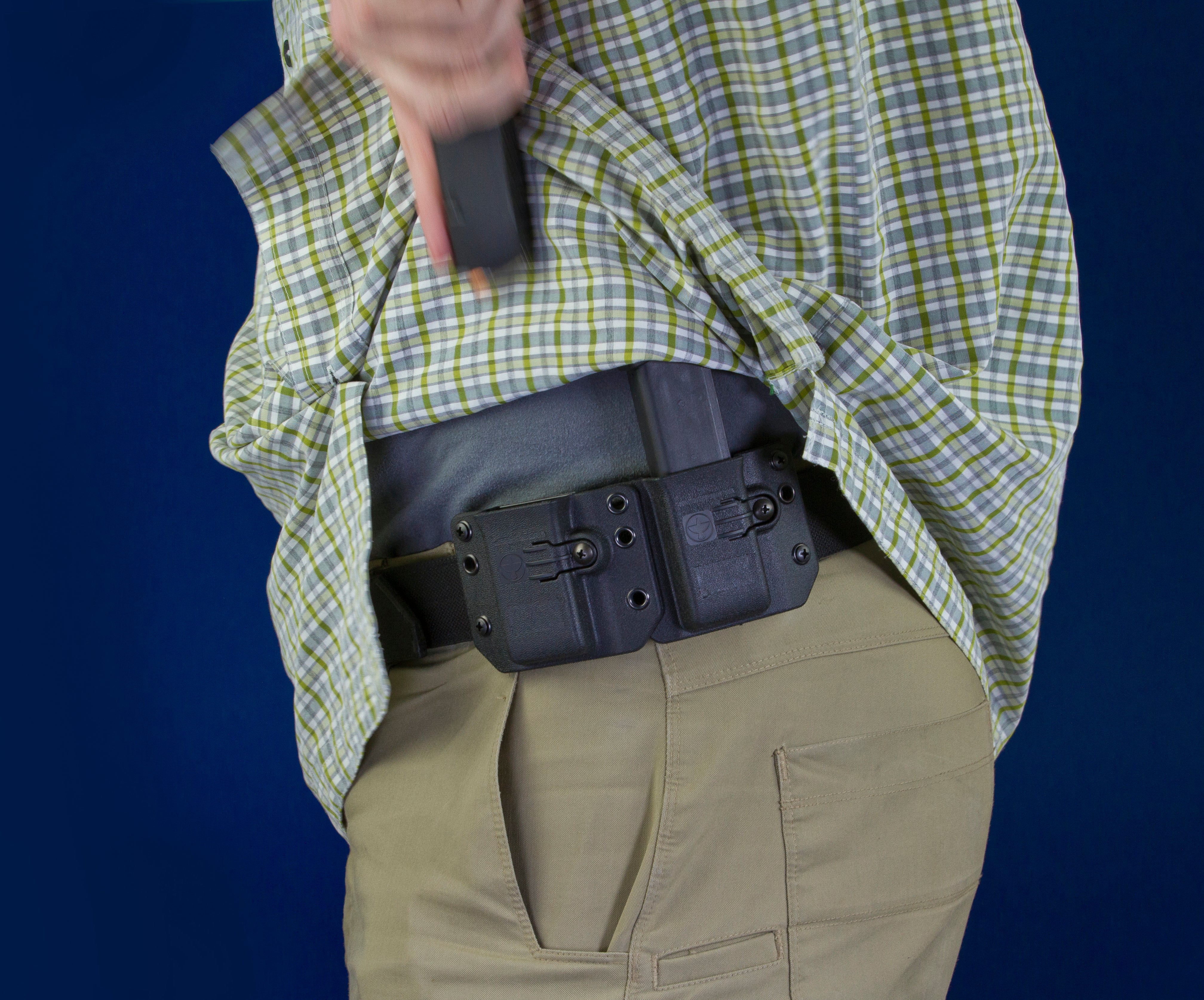
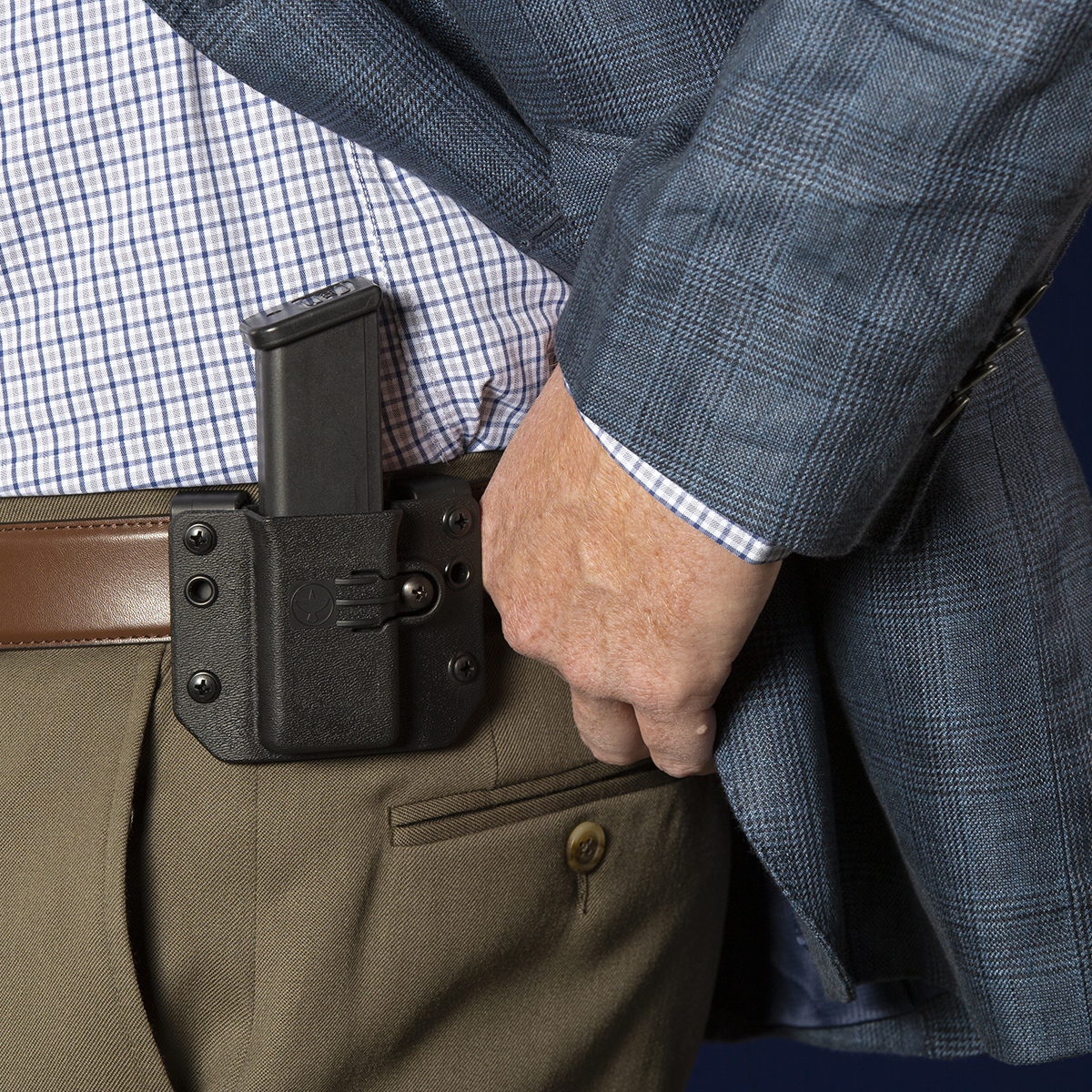
The Copia pistol magazine carrier sits close to the body. The pancake design keeps each magazine tight to the torso, reducing the cross-section that prints through a cover garment and positioning the weight of the magazine against the hip rather than away from it.
The short body variant reduces the vertical footprint for carriers who need a lower profile or are working with a narrower belt section. The tall body variant accommodates the full range of RCS modular belt attachments — IWB soft loops, OWB belt loops, and the QMS quick-mount system — giving the carrier full positional flexibility across carry configurations.
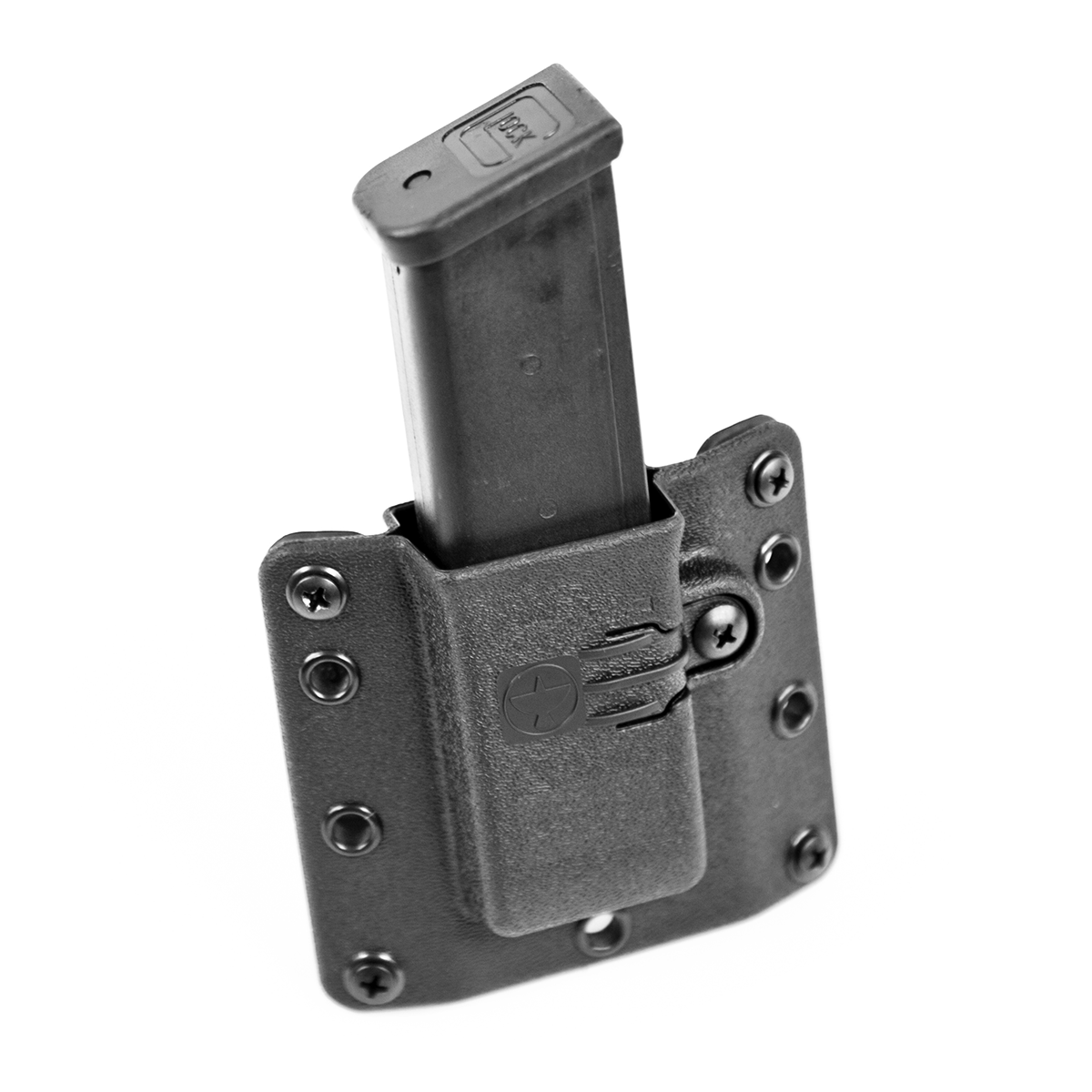
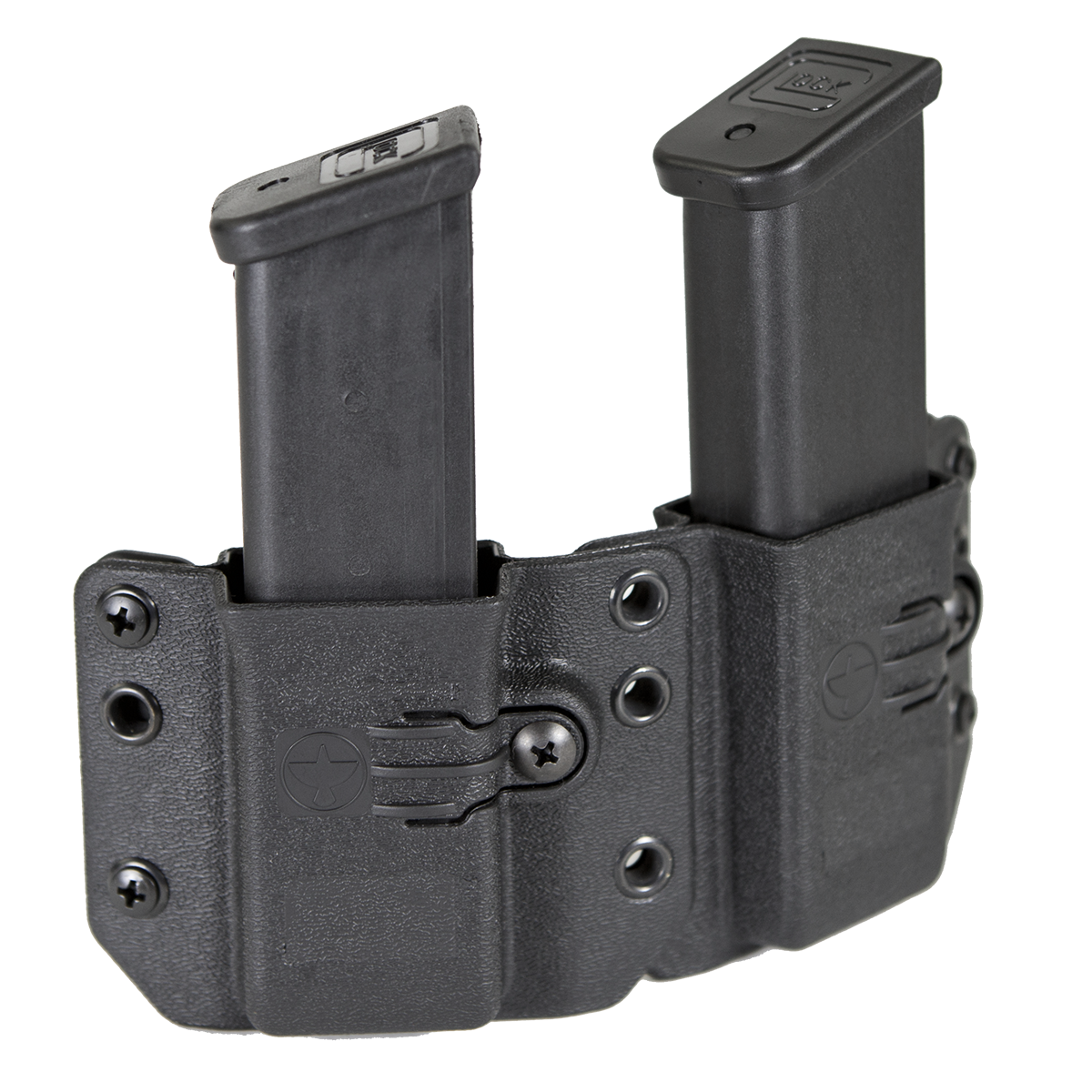
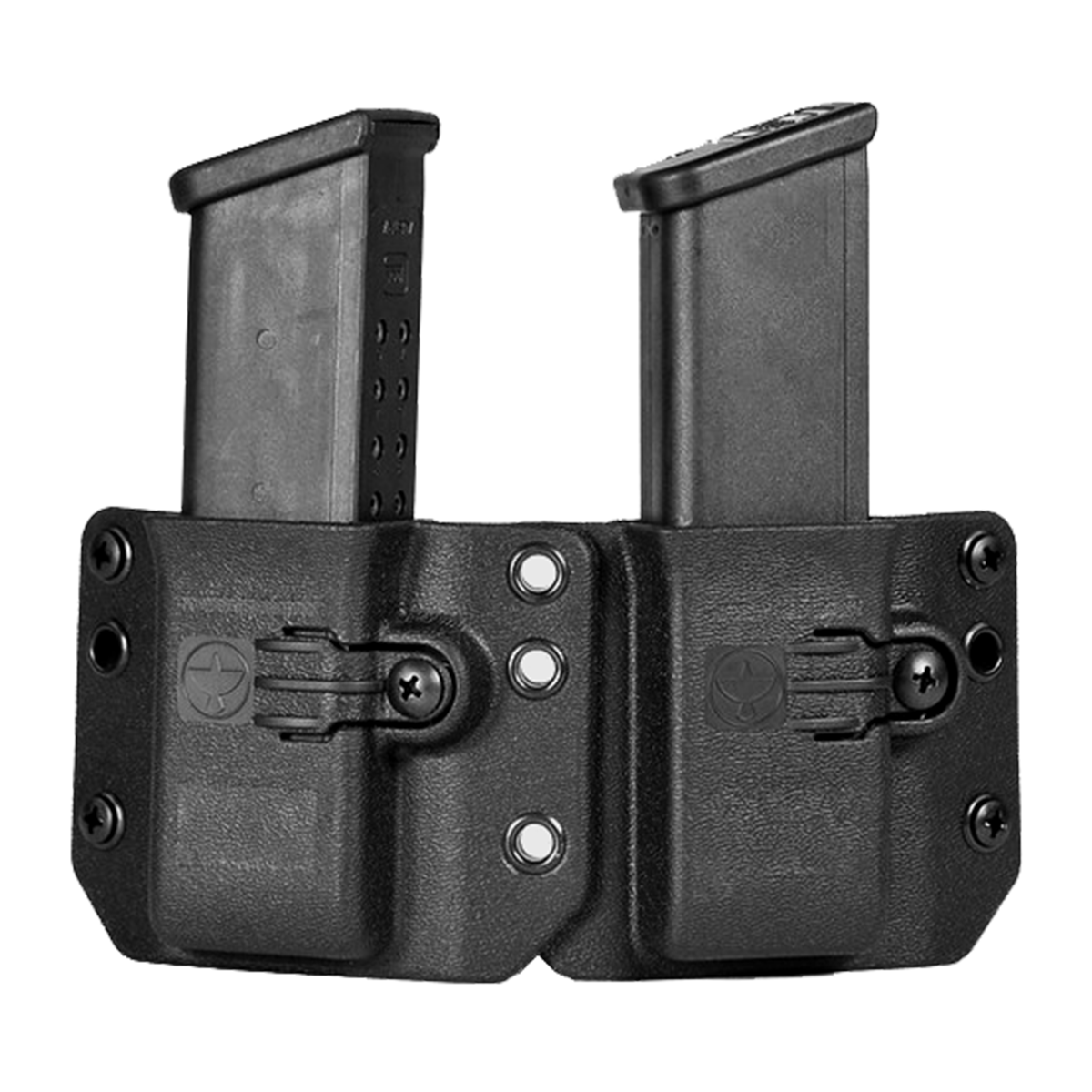
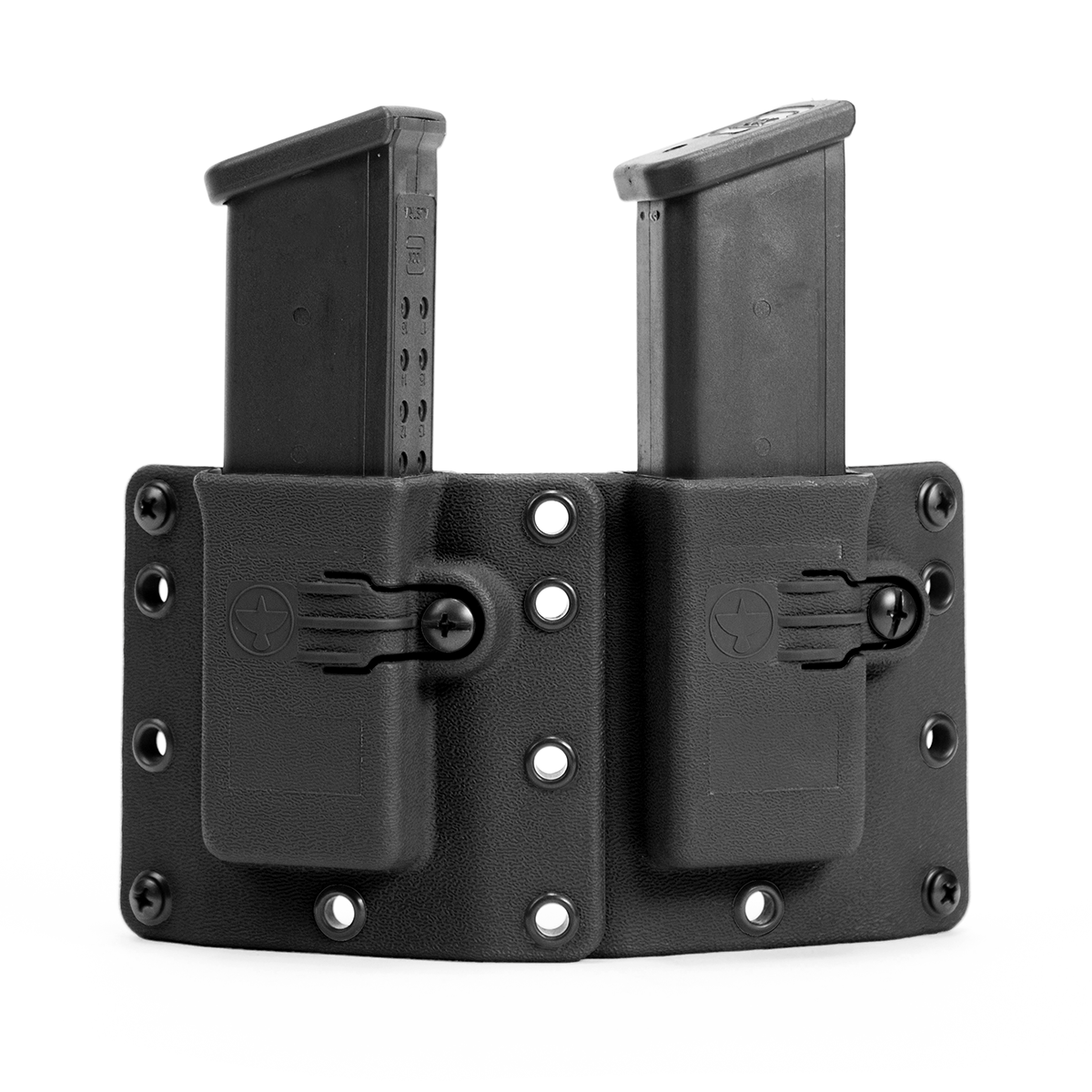
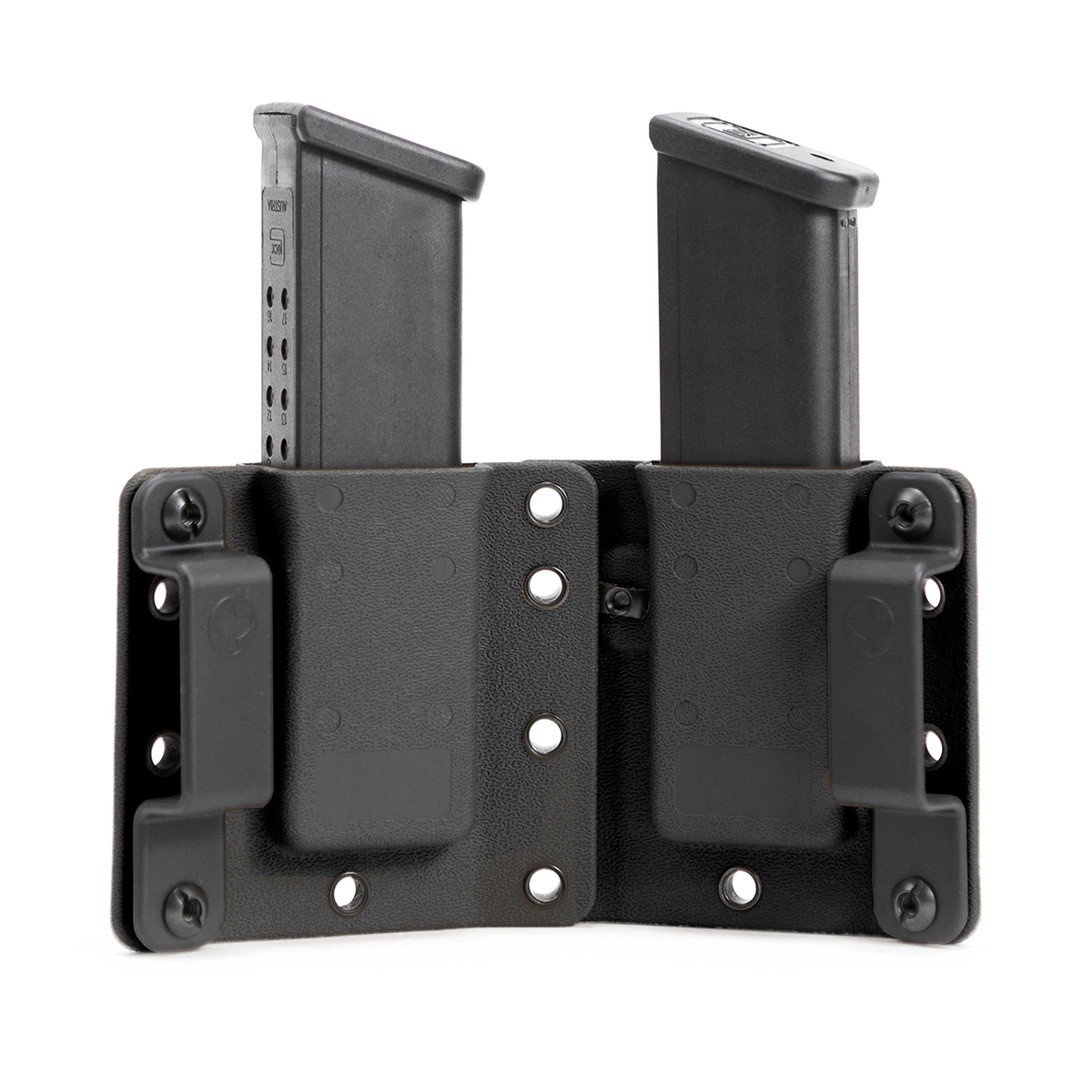
The Copia ships with standard OWB loops, but it is not an OWB-only carrier. The same Phantom-compatible attachment system that allows the Phantom holster to transition between OWB and IWB configurations applies here — swap the loops for tuckable overhooks or soft loops, available separately, and the Copia runs IWB. The tall body supports the full range of IWB attachment options. The short body does not. Two Copia units can be configured as a double-magazine setup two ways: order a factory double, where two singles are permanently riveted together at the center seam for maximum durability and minimum hardware, or link two individual singles yourself using the separately purchased hardware kit. The joined configuration extends along the belt line; the cross-section toward the body does not change.
Accessibility Across Carry Configurations
Magazine carrier accessibility is not simply about speed of draw. It is about whether the carrier disappears from awareness between reloads — whether the user can move, sit, drive, and work without the carrier becoming something they manage rather than something they wear.
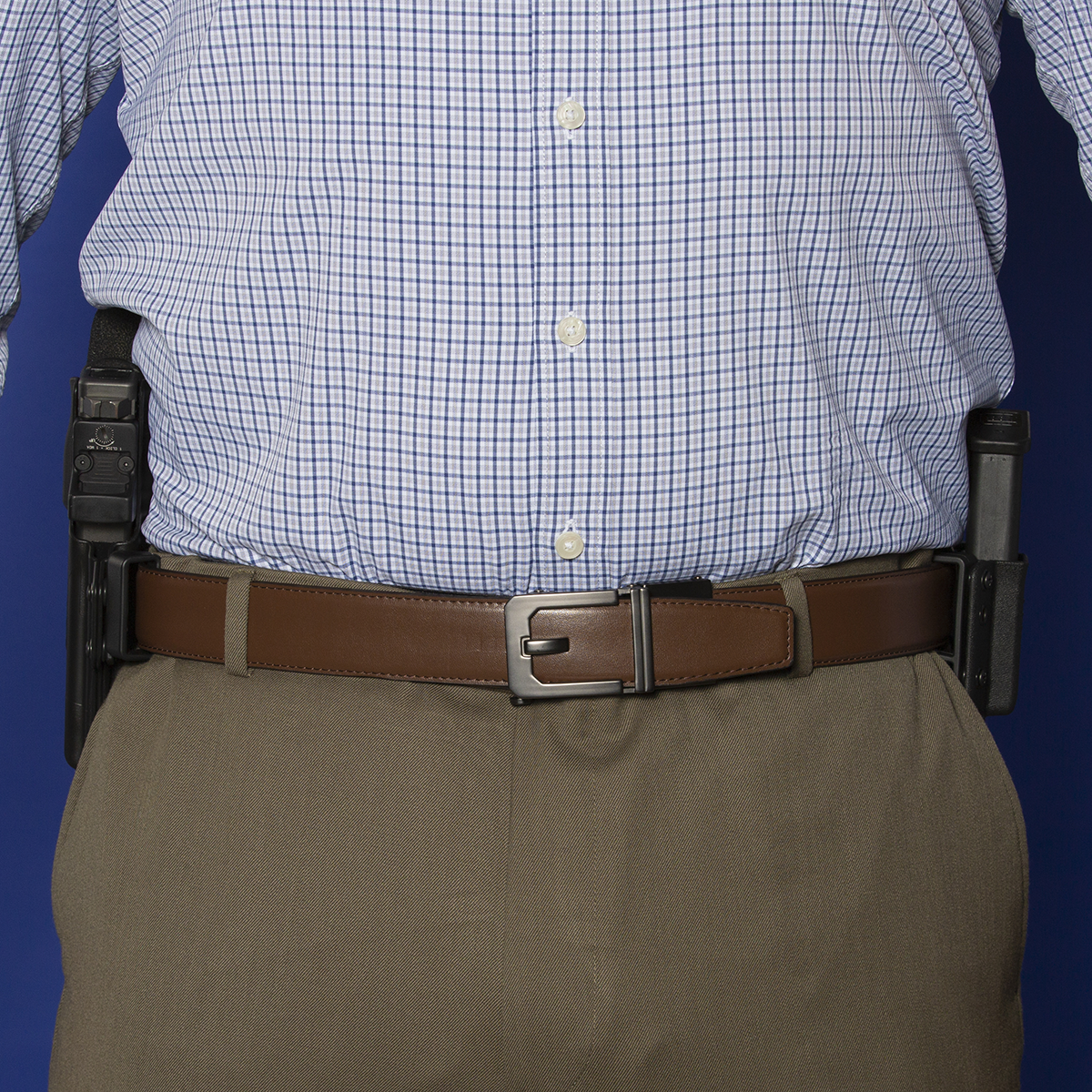
For users who wear body armor or other load carriage that requires standoff from the body, the Copia is compatible with the same drop/offset kit as the Phantom and Phantom LC, available separately. The drop/offset kit moves the carrier out and down from the belt line to accommodate the added bulk underneath — the same kit works across the entire Copia suite. The problem it solves is geometry, not convenience: body armor changes the distance between the belt and the draw hand, and the drop/offset kit restores the carry position to where it needs to be.
For plainclothes professionals — law enforcement, protective details, federal users in casual or business dress — the Copia's profile works under the cover garments that plainclothes carry demands. A carrier that prints through a polo shirt or creates a visible ridge under a sport coat defeats the purpose of plainclothes work. The Copia's cross-section is designed to stay below that threshold.
The modular attachment system allows configuration across belt widths and carry positions without requiring a different carrier body. Professionals who run the same magazine platform across uniform and plainclothes assignments can run the same Copia across both.
When Scale Changes the Requirements
The Copia pistol magazine carrier was developed to fulfill a government contract requirement. The specification that drove its design was not theoretical — it came from an organization that issued one pistol platform to its own personnel and a different platform to contractors in the field, and needed a single carrier that handled both without modification.
Government contract issuance demands something individual carry does not: the carrier must work for every person in the organization, across every pistol in the approved armory, across every assignment type and carry configuration. It cannot be tuned for one body type, one platform, or one way of wearing it. It has to work the first time, without individual adjustment, for every user.
Individual carriers can adapt around weaknesses. Issued equipment cannot.
Retention That Stays Calibrated
The Copia pistol magazine carrier approaches retention differently from a dedicated single-platform carrier.
A carrier built for one magazine model can fix its retention cavity to that model's exact dimensions. A carrier built for 100+ models cannot. The design solution is adjustable retention: the user calibrates the carrier to the specific magazine they are carrying, rather than inheriting a middle-tolerance assumption that applies to no individual platform precisely.
On double configurations, this matters more than it might appear. Most double magazine carriers use a single retention screw that controls compression across both magazine cavities simultaneously — which means tuning retention for one magazine body automatically compromises retention on the other. The Copia's double configuration provides a separate retention screw for each magazine, so each cavity can be independently calibrated to the specific magazine it holds. Two magazines with different body tolerances each get the retention they need.
The adjustable retention system works across the full range of double-stack magazines the carrier accepts — steel body and polymer body, full-size and compact, service grade and training grade. Once set per cavity, it holds without requiring periodic recalibration.
Set it once. It stays.
Select your configuration above to view available configurations.
Ambidextrous by Design
The Copia pistol magazine carrier is not an ambidextrous variant of a right-handed carrier. It is a carrier that has no dominant-hand orientation.
The magazine seats forward or rearward facing in the same body. That means the user determines the draw stroke geometry that matches their carry setup — not the other way around. A right-handed carrier and a left-handed carrier both configure the same unit. No separate SKU. No modification.
For organizations issuing to personnel with different hand orientations, the practical implication is direct: one part number covers the population. Configuration is handled by the user at the time of setup, not by the procurement officer at the time of order.
Short and Tall Body Variants
The Copia pistol magazine carrier is available in two body heights: short and tall.
The short body reduces the vertical footprint of the carrier on the belt — designed for carriers who need a lower profile. It is compatible with a subset of RCS modular belt attachments.
The tall body accepts the full range of Phantom-pattern belt attachments — pancake wings, QMS, tuckable overhooks, IWB soft loops, and others — all sold separately.
The retention geometry, insertion design, and multi-platform cavity are identical between the two. Short or tall is an attachment compatibility decision.
Magazine Compatibility
The Copia pistol magazine carrier accepts double-stack magazines from pistols chambered in 9mm, .40 S&W, and .357 SIG — including Glock G17, G19, G22, G23, G26, G27, G31, G32, G33, G34, G35, G45, G17 Gen 5, and G19 Gen 5; Sig Sauer P226, P227, P229, P320 Full, P320 Compact, and P320 Carry; Beretta 92FS, M9, M9A1, and 90two; FN FN509, FNX-9, FNX-40, FNS-9, and FNS-40; Smith & Wesson M&P 9, M&P 40, M&P 9 2.0, M&P 40 2.0, M&P 9 Compact, and M&P 9 M2.0 Compact; HK VP9, VP40, P30, P30L, and USP; Walther PPQ M2, PDP Full, and PDP Compact; Springfield Armory XD 9, XD 40, XDM 9, XDM 40, and Hellcat Pro; and CZ 75, CZ P-07, and CZ P-09 pistols.
Glock
- G17, G19, G22, G23, G26, G27, G31, G32, G33, G34, G35, G45, G17 Gen 5, G19 Gen 5
Sig Sauer
- P226, P227, P229, P320 Full, P320 Compact, P320 Carry
Beretta
- 92FS, M9, M9A1, 90two
FN
- FN509, FNX-9, FNX-40, FNS-9, FNS-40
Smith & Wesson
- M&P 9, M&P 40, M&P 9 2.0, M&P 40 2.0, M&P 9 Compact, M&P 9 M2.0 Compact
HK
- VP9, VP40, P30, P30L, USP
Walther
- PPQ M2, PDP Full, PDP Compact
Springfield Armory
- XD 9, XD 40, XDM 9, XDM 40, Hellcat Pro
CZ
- CZ 75, CZ P-07, CZ P-09
Additional fitments available. Select your configuration above to confirm compatibility.
Current RCS Customer Note
The Copia uses the same attachment system as the Phantom holster. If you already own Phantom-compatible belt attachments — pancake wings, QMS, tuckable overhooks, IWB soft loops — that hardware transfers directly to the Copia without additional purchase. Standard OWB loops are included. For users who want to run the Copia IWB, the hardware path is the same as the Phantom: remove the included OWB loops, install tuckable overhooks or soft loops purchased separately, and the carrier moves inside the waistband. Tall body only for IWB configurations. The full range of compatible attachments is available here: [LINK — developer to populate before launch].
Frequently Asked Questions
Can the Copia pistol magazine carrier hold my magazine securely even though it accepts multiple platforms?
Yes. The Copia uses an adjustable retention system rather than a fixed-tolerance cavity, which means you calibrate it to your specific magazine rather than inheriting a compromise tolerance meant to cover 100+ platforms. Set the retention to the magazine you're carrying and it holds with the consistency of a dedicated single-platform carrier. The adjustment is done once and does not require periodic recalibration under normal use.
What is the difference between the Copia Pistol short body and tall body?
The short body has a reduced vertical footprint and is compatible with a subset of RCS modular belt attachment options. The tall body is compatible with the full range of Phantom-pattern belt attachments — standard OWB loops, pancake wings, QMS, tuckable overhooks, and IWB soft loops. If you already own Phantom-compatible hardware, it transfers directly to the tall body Copia. The retention geometry, insertion design, and multi-platform cavity are identical between the two. Short or tall is an attachment compatibility decision.
What pistol magazines does the Copia accept?
The Copia accepts double-stack magazines chambered in 9mm, .40 S&W, and .357 SIG from steel and polymer body pistols across more than 100 models, including Glock, Sig Sauer, Beretta, FN, HK, Walther, Springfield, Smith & Wesson, and CZ. It does not accept single-stack magazines, which require a different carrier geometry. The Kari magazine carrier is designed for single-stack and compact frame platforms.
Is the Copia left-hand compatible?
Yes. The Copia has no dominant-hand orientation. The magazine seats forward or rearward facing in the same carrier body, which means either hand orientation is accommodated without modification or additional hardware. There is no left-hand variant because none is needed.
Can I run two Copias together as a double-magazine setup?
Yes, two ways. The factory double is two singles permanently riveted together at the center seam — it is the more durable option and uses less hardware than a field-linked pair. Alternatively, two individual singles can be linked using the separately purchased hardware kit. Either way, the double configuration extends along the belt line without adding cross-section toward the body, and each magazine cavity has its own independent retention screw so you can calibrate each position separately.
Does the Copia work with a drop/offset kit?
Yes. The Copia is compatible with the same drop/offset kit as the Phantom and Phantom LC, sold separately. For users who wear body armor or load carriage that adds bulk between the belt and the body, the drop/offset kit moves the carrier out and down from the belt line to accommodate the added standoff. The same kit works across the entire Copia suite — pistol, rifle, and combo configurations.
Can the Copia pistol carrier be carried IWB?
Yes, with the tall body. The tall body is compatible with the full range of Phantom-pattern IWB attachments — tuckable overhooks, soft loops, and others — available separately. IWB carry works well with the standard tall body configuration. The short body is not well suited to IWB carry due to its reduced attachment compatibility. If IWB is your intended configuration, order the tall body.
What belt does the Copia require?
The Copia uses the same attachment system as the Phantom holster and ships with standard OWB loops included. Compatible attachments — pancake wings, QMS, tuckable overhooks, IWB soft loops, and others — are available separately. If you already own Phantom-compatible hardware, it transfers directly to the Copia without additional purchase.
What magazine carrier works for plainclothes carry?
For plainclothes work, the primary requirement is low cross-section against the body. The Copia's pancake design keeps the magazine tight to the torso, which reduces the profile that prints through a polo shirt, sport coat, or untucked button-down. The short body variant further reduces the vertical footprint for carriers who need the smallest possible profile.
Is the Copia used by law enforcement or government agencies?
The Copia was developed to fulfill a government contract requirement for an ambidextrous, multi-platform pistol magazine carrier capable of handling two different issued pistol platforms simultaneously. It has been adopted across professional law enforcement and government applications.
Technical Specifications
| Feature | Specification |
|---|---|
| Product Type | Pistol magazine carrier |
| Material | Injection-molded polymer |
| Configuration | Single |
| Body Variants | Short / Tall |
| Magazine Compatibility | Double-stack pistol magazines — steel and polymer — 9mm / .40 S&W / .357 SIG |
| Compatible Platforms | 100+ pistol models — see fitments section |
| Retention | Adjustable — independent screw per magazine cavity on double configuration |
| Insertion Orientation | Ambidextrous — magazine forward or rearward facing |
| Belt Attachments Included | Standard OWB loops |
| Belt Attachments Compatible | Phantom-pattern — pancake wings, QMS, tuckable overhooks, IWB soft loops (sold separately) |
| Drop/Offset Kit | Compatible with Phantom / Phantom LC drop/offset kit (sold separately) |
| Country of Origin | USA |
| Warranty | Unconditional lifetime warranty |
Choose options

made in the usa
100% all parts and materials