
Executive VanGuard (EVG)
Executive VanGuard (EVG) AIWB Holster
Minimalist carry, taken to its logical conclusion.
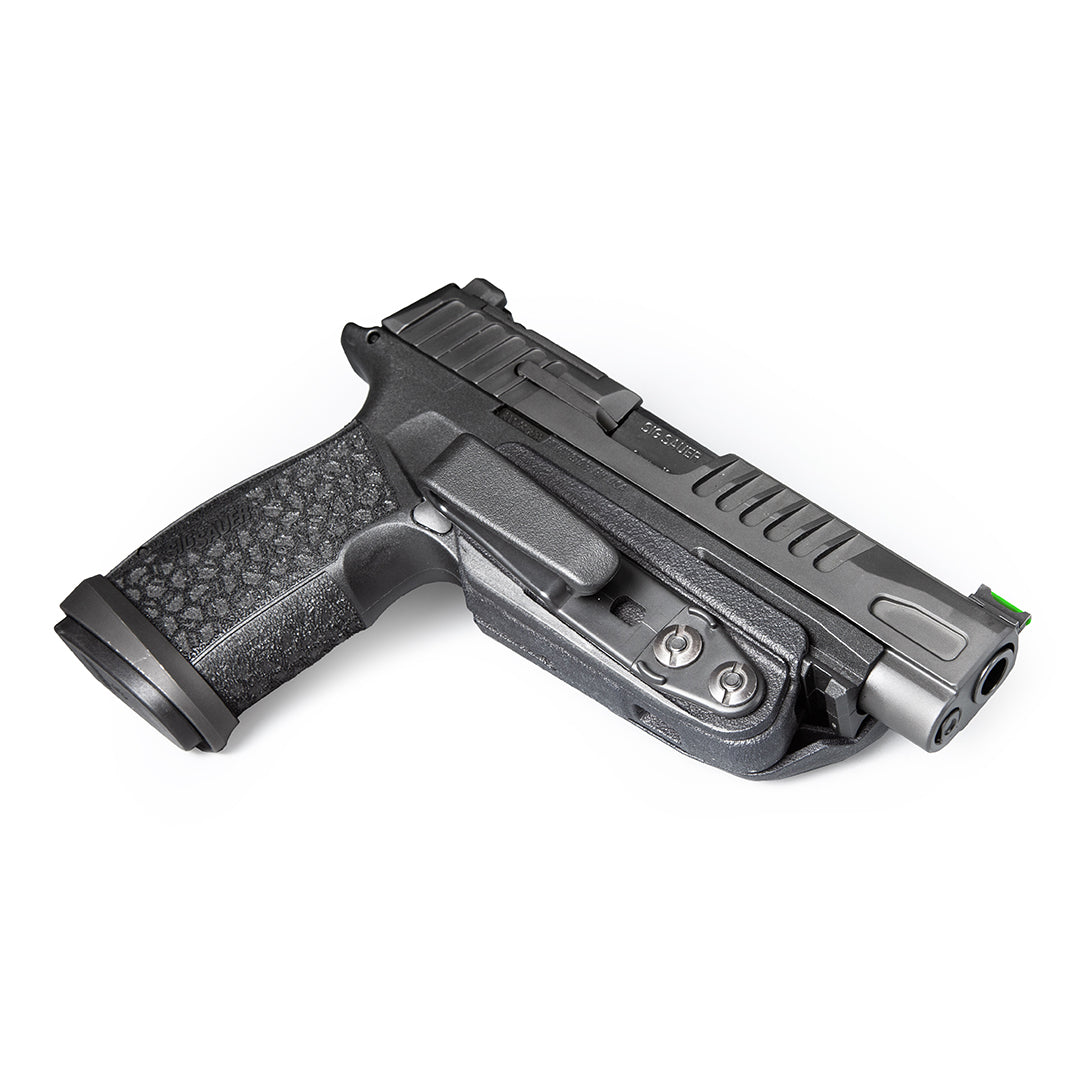
Built on the VanGuard's minimalist DNA and executed in the medium of advanced additive manufacturing, the EVG integrates grip tuck and slide control directly into the holster body. No external hardware required.
Made in USA | Unconditional lifetime warranty | Additive manufactured to order
Before You Order
The EVG is designed specifically for slimline and compact concealed carry pistols listed in the fitment selector above.
The EVG is not intended for:
- Weapon-mounted light configurations
- OWB carry
- Pistol models not listed in the fitment selector
- Carriers expecting immediate shipment
If your carry pistol is equipped with a weapon-mounted light, the EVG is not the correct platform for that configuration.
Quick Scan
| Feature | Detail |
|---|---|
| Carry Position | Appendix IWB (AIWB) |
| Series | Executive Select Series |
| Coverage | Trigger guard only |
| Compatible With | Slimline and compact pistols |
| Fitments | Glock 43/43X/43X MOS/48/48X/48X MOS, Sig Sauer P365-XMACRO — see available fitments below |
| Optics Ready | Yes — all current fitments |
| Light Compatible | No |
| Threaded Barrel Compatible | Yes |
| Claw Required | No — grip tuck is handled by the EVG wedge |
| Wedge | Purpose-engineered component — screws onto trigger guard shell |
| Firearm Retention | Passive, fixed — audible click on full seating |
| Combined Width | No wider than the firearm itself |
| Belt Attachments | Compatible with RCS IWB hardware and aftermarket overhooks — ride height and cant adjustable |
| Hand Orientation | Left and right hand available |
| Color | Black |
| Price | $90 |
| Production | Made to order |
| Lead Time | Up to 12 weeks from order |
| Made in USA | Yes |
| Warranty | Unconditional lifetime warranty — follows the product, not the purchaser |
Best For: Appendix Carry and Minimalist Concealment
- Carriers who want the most resolved minimalist AIWB holster available
- Daily concealment without external claws or aftermarket accessories
- Carriers running slimline or compact pistols with slide-mounted optics
- Professional and plainclothes environments requiring maximum simplicity
- Carriers who have experienced knuckle interference or belt-dependent claw performance
- Anyone who wants the VanGuard concept elevated to Executive Select standards
The Standard
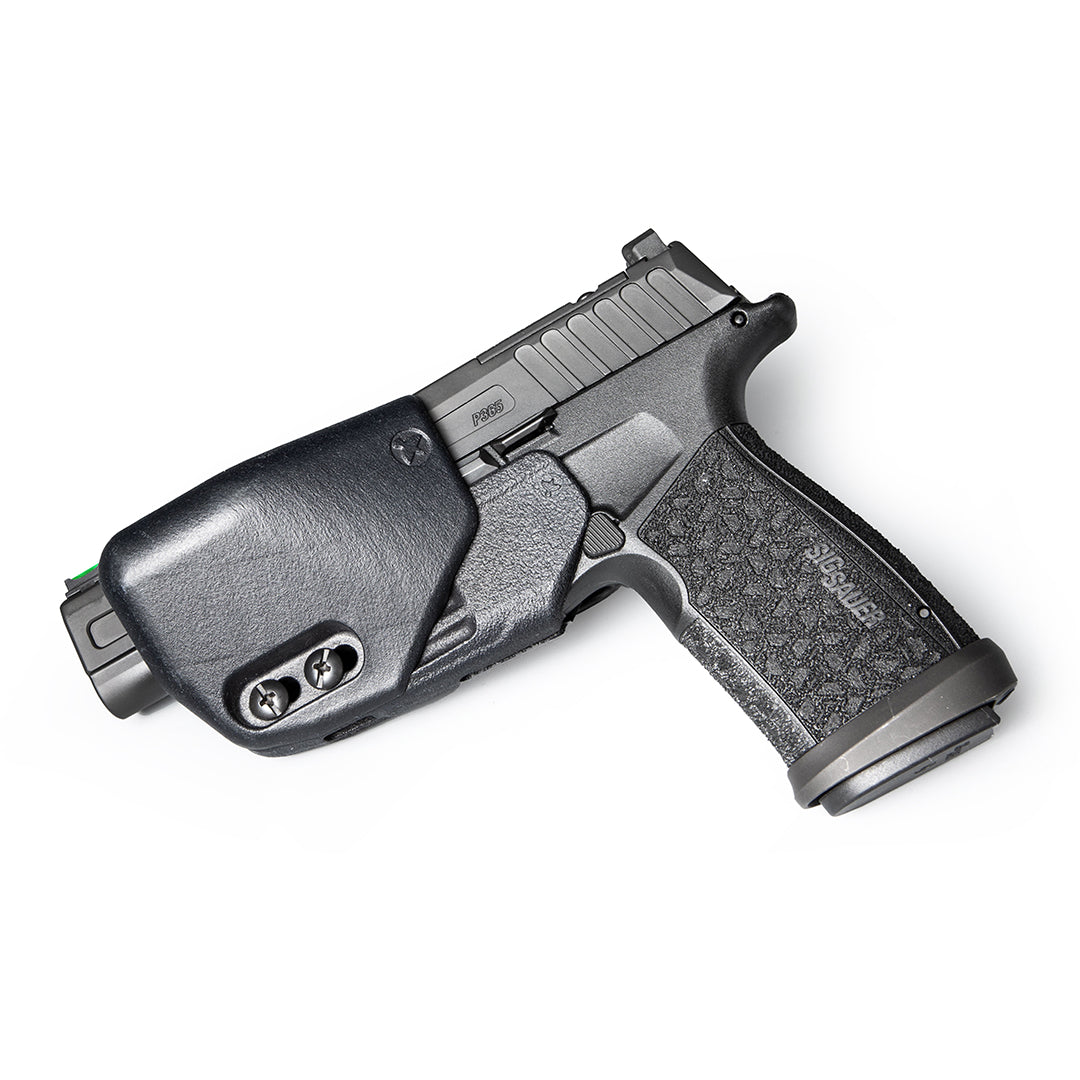
The Executive VanGuard EVG is a minimalist AIWB holster covering only the trigger guard, built to eliminate the claw entirely through geometry rather than supplement it through hardware.
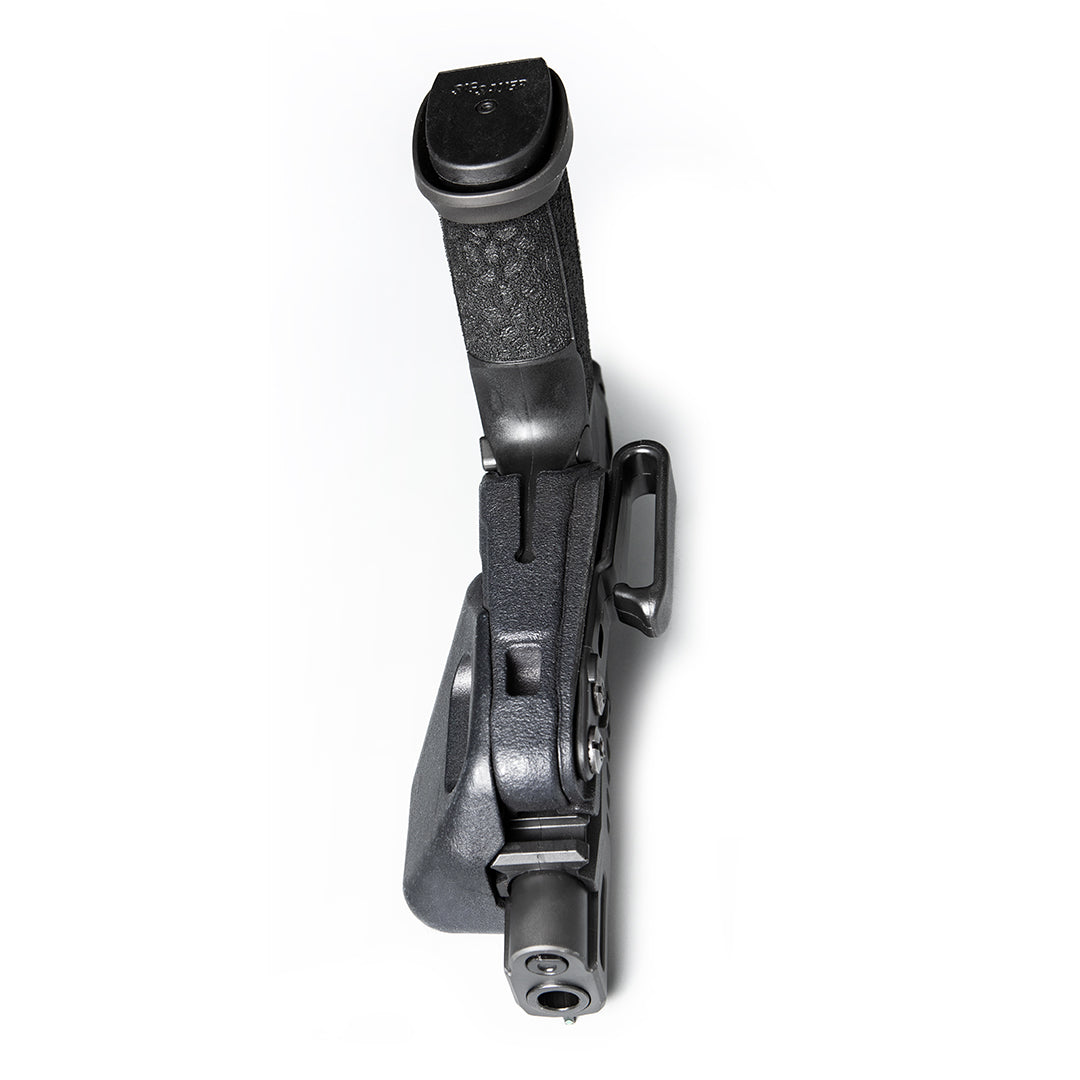
A slimline pistol, no wider than the gun itself.
No claw. No aftermarket accessories required to achieve concealment.
The VanGuard line has defined minimalist concealment carry since 2012. The original VanGuard 2 covered only the trigger guard and added nothing to the width of the pistol. Every version that followed maintained that standard. The EVG preserves it and advances it with the design freedom that additive manufacturing and Soma Form geometry provide.
Conventional minimalist holsters address grip printing through an external claw that levers against the belt. That solution works. It also introduces belt dependency, adds width, and at certain ride heights and cant angles, places hardware directly in the path of the master grip on the draw stroke.
The EVG does not use a claw.
Built using the same advanced additive manufacturing process as the VSB, the EVG's purpose-engineered wedge screws directly onto the trigger guard shell. Once attached, it integrates so seamlessly with the holster body that the assembled system reads as a single piece. It handles both vertical stabilization of the slide and grip tuck simultaneously, without a claw and without width beyond the firearm itself.
For more than two decades, Raven Concealment Systems has focused on a single problem: what does it actually take to carry a real pistol every day. The EVG is what that question produced when the answer was constrained only by geometry.
Good gear disappears from behavior.
What Makes the EVG Work
| Requirement | Why It Matters |
|---|---|
| Grip tuck without external claw | An external claw uses belt pressure as leverage to rotate the grip inward, which means its grip tuck performance varies with belt stiffness. A holster that achieves grip tuck through its own geometry performs consistently regardless of belt construction and introduces no hardware to the draw path. |
| Simultaneous grip and slide control | The two primary printing points in AIWB carry are the butt of the grip and the rear of the slide. Most minimalist holsters address one or the other through a single external attachment. The EVG's integrated wedge addresses both simultaneously through a single piece of geometry. |
| No width penalty | External claws add width below the trigger guard. At certain ride heights and cant preferences, that added width places the claw directly in the path of the master grip on the draw stroke. The knuckles contact the claw before the hand fully seats on the grip. A holster no wider than the firearm itself eliminates both problems. |
| Soma Form exterior geometry | A holster shaped by the firearm's geometry transfers the gun's hard edges and flat surfaces to the carrier's body. Soma Form geometry distributes contact across the body's natural contours, eliminating pressure points and reducing the angular exterior profile that prints through cover garments. |
| Optics clearance without profile compromise | Slide-mounted optics are standard equipment for an increasing proportion of serious carriers. A minimalist holster that cannot accommodate a red dot removes itself from consideration for any configured-pistol buyer, regardless of its other merits. |
| Belt attachment flexibility | Ride height and cant are the variables most commonly adjusted to individual body geometry and garment choice. A holster that fixes those settings removes the carrier's ability to dial in their specific concealment solution. |
The EVG was built around those requirements from the beginning.
The Minimalist Carry Compromise
Minimalist carry strips the holster to its essential functions: covering the trigger guard, anchoring the pistol securely to the belt, and orienting it for concealment and access. Everything that does not serve those functions is removed. That constraint produces real advantages and real limitations, and understanding both is what separates a carrier who finds the EVG transformative from one who finds it incomplete.
What the EVG gives you
The EVG adds nothing to the width of the pistol. No claw projecting outboard. No attached magazine carrier. No hardware between the holster body and the belt. The carry profile is as narrow as the firearm itself, which means the EVG can be concealed under garments that would immediately betray a conventional holster.
The absence of external hardware also simplifies the carry setup. No components to adjust, break, or lose. No secondary contact points creating hotspots against the body. The EVG goes on, the pistol goes in, and the wedge does the work that external claws and aftermarket inserts typically require several iterations to approximate.
The integrated wedge geometry keeps the rear of the slide and the butt of the grip tight against the body simultaneously. Most minimalist holsters address only one of those two printing sources. The EVG addresses both through a single, resolved design decision.
What the EVG asks of you
The EVG covers only the trigger guard. It does not provide a full holster body between the pistol and the carrier's skin. Carriers who prefer body shield coverage between the slide and their skin, or who carry firearms with slide serrations that abrade fabric over extended wear, should consider whether the EVG's minimalist coverage is the right fit for their daily carry.
The EVG also does not include an integrated magazine carrier. Carriers who want a pistol and spare magazine in a single holster should consider the VSB.
The EVG is optimized for slimline and compact pistol platforms. Carriers running full-size duty pistols should confirm fitment availability before ordering, as the line is expanding.
The tradeoff in plain terms
The EVG is not the most feature-complete minimalist holster available. It is the most geometrically resolved one. For a carrier who wants to eliminate external hardware and carry with maximum simplicity, the EVG is the correct choice. For a carrier who requires body shield coverage or an integrated spare magazine, it is not.
In civilian and professional concealment contexts, the draw stroke is what happens every day. The EVG is optimized for that, not for the features that make a holster more complex to set up.
Know which problem you are solving. The EVG solves the concealment problem with the minimum hardware required.
The Profile
The Executive VanGuard EVG AIWB holster sits against the body as a narrow, featureless profile no wider than the pistol it carries. The Soma Form exterior has no external claw projecting outboard, no attached hardware pressing against the skin, and no secondary contact points competing with the pistol's grip for space at the waistline.
The integrated wedge fills the void between the holster body and the carrier's lower abdomen. It keeps the rear of the slide from tipping outward at the beltline and simultaneously keeps the butt of the grip from printing through the cover garment. Both functions are handled by the EVG wedge: a component designed specifically for this holster that screws onto the trigger guard shell and, once attached, reads as a seamless part of the assembled system.
Ride height and cant are set through the belt attachment configuration. The EVG's attachment points accept RCS IWB belt hardware and most aftermarket overhooks, allowing the carrier to position the holster precisely for their body geometry and garment choice. Once set, the position holds through movement, seated carry, and the draw stroke.
Carrying the EVG in Professional Contexts
In professional environments, the EVG's value is consistency as much as concealment.
A carrier using a claw-equipped minimalist holster is managing grip tuck performance that varies with their belt. The EVG's wedge achieves grip tuck through geometry rather than belt leverage. It performs the same under a dress belt as under a gun belt. That consistency matters when the carrier's wardrobe is determined by the assignment, not by what works best with the holster.
The profile the EVG presents under fitted professional garments is the profile of the pistol itself. No claw projecting outboard. No magazine carrier extending the footprint. That is the narrowest concealment footprint a holstered firearm can achieve.
For plainclothes law enforcement, executive protection, and experienced civilian carriers in environments where wardrobe constraints dictate what can be carried, the EVG is the correct tool.
The Individual Standard
Issued equipment is optimized for the group.
It has to be.
Large-scale procurement requires systems capable of functioning adequately across broad populations, assignments, uniforms, and operational requirements. The resulting equipment is designed around averages.
The EVG was not designed around averages.
The professionals who carry systems like this on their own account are not rejecting issued equipment. They are acknowledging that individual concealed carry often demands a higher personal standard than institutional standardization can realistically deliver.
Some gear is issued.
This is chosen.
The Integrated Wedge
The EVG's defining design decision is the elimination of the external claw through integrated geometry.
The claw is the standard solution to grip printing in AIWB minimalist carry. Positioned outboard of the trigger guard, the claw contacts the belt and uses belt pressure to lever the grip of the pistol inward toward the body. It works. It also introduces three problems that the EVG's integrated wedge eliminates.
First, claw performance for grip tuck is belt-dependent. A stiff gun belt maximizes claw leverage. A lighter dress belt reduces it. The same holster achieves different levels of grip tuck depending on what the carrier is wearing, which means the carrier is always managing that variable rather than relying on a consistent system.
Second, the claw adds width below the trigger guard. At certain ride heights and cant preferences, that added width places the claw directly in the path of the master grip on the draw stroke. The knuckles contact the claw before the hand fully seats on the grip. That is a training problem, a comfort problem, and a speed problem simultaneously.
Third, the claw addresses grip printing only. It does not address the rear of the slide tipping outward at the beltline, which is the other primary printing source in AIWB carry. A carrier using a claw-equipped holster is solving half the printing problem.
The EVG's wedge is a purpose-engineered component that screws directly onto the trigger guard shell. Once attached, it integrates so seamlessly with the holster body that the assembled system reads as a single piece. There is no visible seam, no proud edge. The wedge was designed for this holster and this geometry from the beginning.
It fills the void between the holster and the carrier's body, keeping the rear of the slide tight against the torso and simultaneously rotating the grip inward. Both printing sources addressed by a single component, with grip tuck performance that does not vary with belt stiffness.
The assembled system is no wider than the firearm itself.
Select your pistol above to view available configurations.
Soma Form in a Minimalist Platform
The EVG applies Soma Form design to the most constrained holster format available: trigger guard coverage only.
Soma derives from the Greek word for body. Soma Form is the design principle that the human body, not the firearm, is the primary geometric reference for the holster. In a full holster body like the VSB, Soma Form shapes an extensive exterior surface. In the EVG, the contact surface is smaller but the principle is identical: the geometry touching the carrier should be optimized for the carrier first.
Conventional minimalist holsters are shaped by the firearm. The trigger guard cavity defines the form. What surrounds it is whatever geometry the manufacturing process makes simplest to produce. The result is a small gun-shaped object pressed against the body.
The EVG is shaped differently. The exterior geometry follows the natural contour of the lower abdomen in the AIWB carry position, distributing contact across the body's natural curvature rather than concentrating it at the hard corners of the trigger guard housing. Advanced additive manufacturing enables this. Thermoformed Kydex and injection molding cannot.
The geometry is not intended to mimic the silhouette of the firearm. It is intended to follow the geometry of the person carrying it.
Optics and Pistol Compatibility
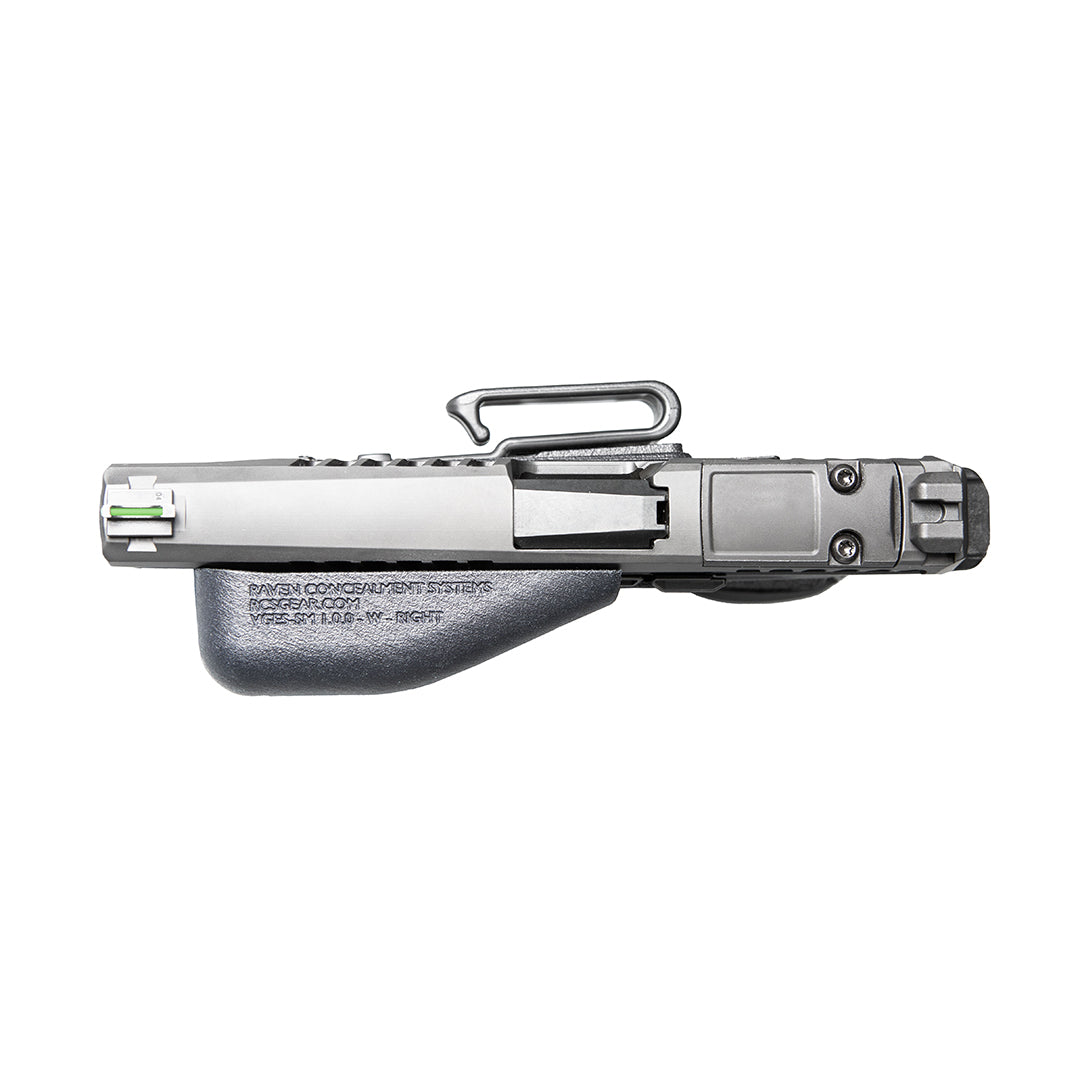
The Executive VanGuard EVG accommodates slide-mounted optics across all current fitments. Running a pistol-mounted red dot in the EVG is a fully supported configuration.
Compatible optics include:
- Trijicon RMR / SRO
- Holosun 507C / 508T
- Holosun EPS
- Leupold DeltaPoint Pro
- Sig Sauer Romeo1 Pro
- Shield RMSc / SMS
- Additional configurations — confirm with your fitment using the selector above
Optics compatibility will expand as larger frame fitments are added to the EVG line. Confirm your specific optic and fitment combination using the selector above.
The EVG is a non-light-bearing holster. No weapon light configurations are currently available.
Threaded barrel compatibility: Yes. The EVG uses an open muzzle design across all fitments, providing clearance for threaded and extended barrels.
Suppressor-height front sight clearance: Yes, across all current fitments.
Available Fitments
The Executive VanGuard EVG is currently available for the Glock 43, Glock 43X, Glock 43X MOS, Glock 48, Glock 48X, Glock 48X MOS, and Sig Sauer P365-XMACRO pistols. The EVG was developed to serve professional and experienced civilian carriers who require the most geometrically resolved minimalist AIWB holster available — covering the primary slimline and compact pistol platforms where trigger-guard-only carry without an external claw is the operational requirement.
Glock
- 43 / 43X / 43X MOS
- 48 / 48X / 48X MOS
Sig Sauer
- P365-XMACRO
Additional fitments including compact and full-size Glock and Sig Sauer platforms are in development. Select your pistol above to confirm compatibility.
Current RCS Customer Note
The Executive VanGuard EVG uses belt attachment hardware that differs from legacy RCS IWB product generations, including the original VanGuard 2 and VanGuard 3. If you are an existing RCS customer, your current attachment hardware may not be compatible with the EVG's attachment points. Current EVG-compatible attachment options are available here: [LINK — confirm URL with developer before launch].
Frequently Asked Questions
What is the difference between the EVG and the original VanGuard 2?
The VanGuard 2 is injection-molded polymer covering the trigger guard with conventional attachment hardware. The EVG uses advanced additive manufacturing and Soma Form geometry to replace the external claw with a dedicated wedge that screws onto the trigger guard shell and integrates seamlessly with the holster body. The EVG also accommodates slide-mounted optics across all fitments. The VanGuard 2 remains available as the standard-line option. The EVG is the Executive Select Series evolution of that concept.
What is the difference between the EVG and the VSB?
The VSB is a full AIWB holster body with an integrated piggyback magazine carrier, designed for carriers who want a pistol and spare magazine in a single holster. The EVG covers only the trigger guard and carries no magazine. It is the more minimal of the two ESS AIWB options. Carriers who want maximum simplicity and minimum footprint should choose the EVG. Carriers who want an integrated spare magazine should choose the VSB.
Why does the EVG not use a claw?
Because the EVG's wedge solves the same problem more completely. The wedge addresses both grip printing and slide printing simultaneously through a single component that screws onto the trigger guard shell and integrates seamlessly with the holster body. External claws address grip printing only, vary in performance with belt stiffness, add width below the trigger guard, and can interfere with the master grip on the draw stroke. The EVG eliminates all three of those drawbacks.
Is the EVG optics compatible?
Yes. The EVG accommodates slide-mounted red dot sights across all current fitments, including the Trijicon RMR/SRO, Holosun 507C/508T, Holosun EPS, Leupold DeltaPoint Pro, Sig Sauer Romeo1 Pro, and Shield RMSc/SMS. Optics compatibility will expand as larger frame fitments are added. Confirm your specific optic and fitment combination using the selector above.
Can the EVG accommodate threaded barrels?
Yes. The EVG uses an open muzzle design across all fitments, providing clearance for threaded and extended barrels without modification.
Is the EVG available for left-handed carriers?
Yes. The EVG is available in both left and right hand configurations. Select your hand orientation using the selector above.
What is the best minimalist AIWB holster without a claw?
The EVG is the only minimalist AIWB holster that eliminates the external claw through integrated wedge geometry rather than simply omitting it. Most claw-free minimalist holsters sacrifice grip tuck entirely. The EVG maintains grip tuck and slide control through a wedge engineered specifically for this holster body, with no external claw and no width beyond the firearm itself.
Does the EVG work without a gun belt?
The EVG requires a belt for attachment, like any IWB holster. What it does not require is a stiff belt for grip tuck. External claws use belt pressure as leverage to rotate the grip inward, so their performance varies with belt stiffness. The EVG's wedge achieves grip tuck through holster geometry rather than belt leverage, so it performs consistently regardless of belt construction. A purpose-built carry belt is still recommended for consistent ride height and holster stability.
Can the EVG be used strong-side IWB?
Yes, with the wedge oriented appropriately for that carry position. The primary design intent is AIWB. Strong-side IWB is a secondary configuration.
How long does the EVG take to ship?
The EVG is made to order. Lead time is up to 12 weeks from the time of order. Every EVG goes through multiple quality assurance checkpoints before shipment. The lead time is a consequence of building to this standard, not a supply constraint.
Is the EVG covered by the RCS warranty?
Yes. The EVG is backed by RCS's unconditional lifetime warranty, which follows the product, not the purchaser.
Technical Specifications
| Feature | Specification |
|---|---|
| Price | $90 |
| Carry Position | Appendix IWB (AIWB) |
| Series | Executive Select Series |
| Design Principle | Soma Form |
| Coverage | Trigger guard only |
| Material | High-strength additive manufactured polymer |
| Exterior Geometry | Body-optimized, smooth organic contours |
| Wedge | Purpose-engineered — screws onto trigger guard shell |
| Claw Required | No |
| Firearm Retention | Passive, fixed — audible click on full seating |
| Magazine Carrier | None — see VSB for integrated magazine option |
| Combined Width at Widest Point | No wider than the firearm |
| Optics Compatible | Yes — all current fitments |
| Light Compatible | No |
| Threaded Barrel Compatible | Yes — open muzzle design |
| Suppressor Height Front Sight Clearance | Yes |
| Belt Attachments | Compatible with RCS IWB hardware and aftermarket overhooks |
| Ride Height and Cant | Adjustable via belt attachment configuration |
| Hand Orientation | Left and right hand available |
| Color | Black |
| Production | Made to order |
| Lead Time | Up to 12 weeks from order |
| Warranty | Unconditional lifetime warranty — follows the product, not the purchaser |
| Country of Origin | USA |
Choose options

made in the usa
100% all parts and materials