
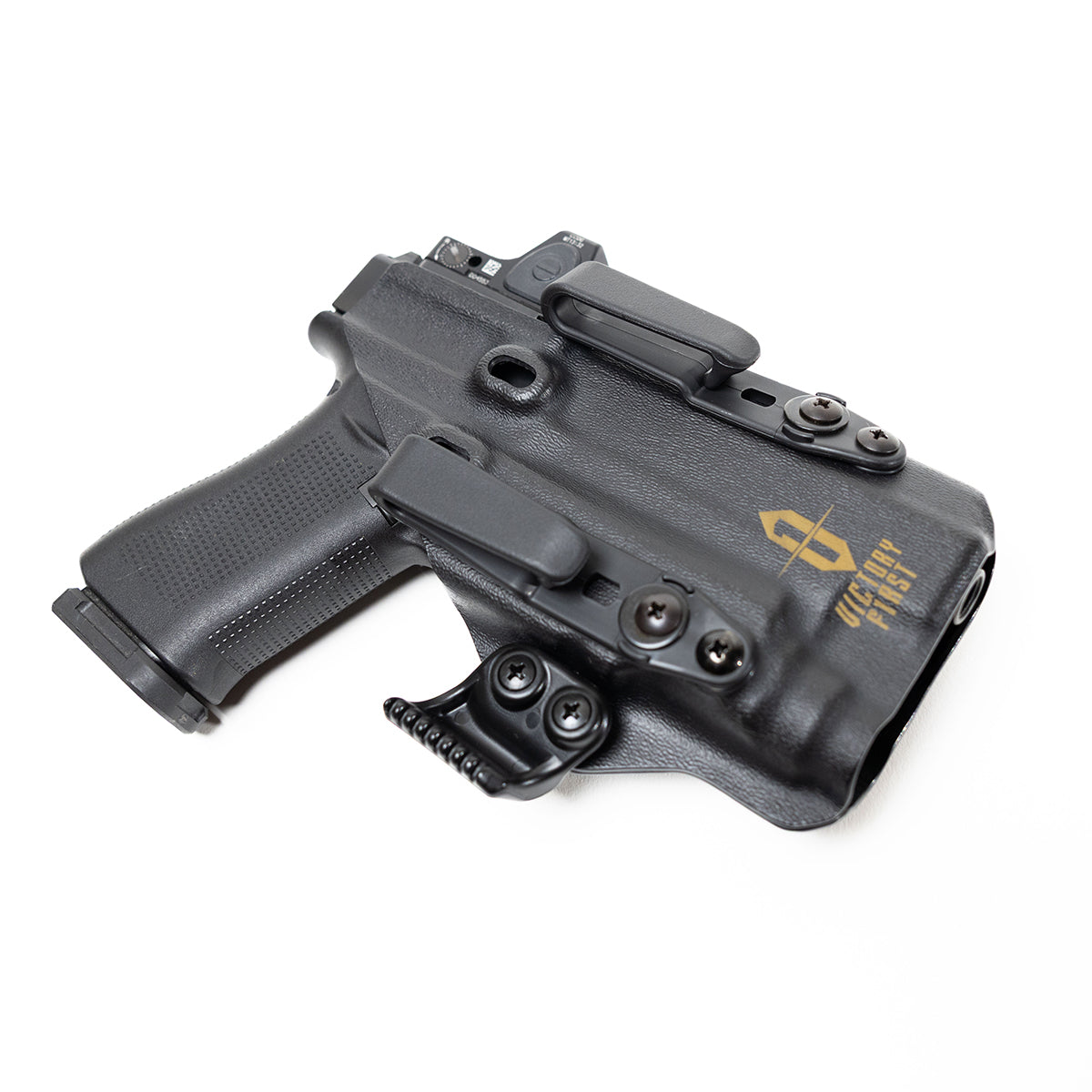
Jake LC for Glock 19 with Surefire XC3
The Jake LC AIWB Holster
Most holsters are designed for the possibility of a threat. The Jake LC was built with input from someone who spent his career being sent to deal with them.
Made in USA | Unconditional lifetime warranty | Designed with a career law enforcement concealment specialist
Quick Scan
| Feature | Detail |
|---|---|
| Carry Position | Appendix IWB (AIWB) — also configurable for strong-side IWB |
| Carry Type | Inside the Waistband (IWB) |
| Compatible With | Compact and full-size pistols equipped with a supported weapon light |
| Pistol Fitments | Glock 19/19X/44/45 (Gen 3–5), Glock 23 (Gen 3–4), Sig Sauer P320C/X-Carry/M18, Sig Sauer P365X Macro — see available fitments below |
| Compatible Lights | Streamlight TLR7A / TLR7X / TLR7HLX |
| Optics Ready | Yes — all fitments |
| Threaded Barrel Compatible | Yes — open muzzle design |
| Belt Attachment Included | Dual 1.5" overhooks; additional wedges included |
| Hand Orientation | Ambidextrous |
| Body Shields | Dual — inboard and outboard, full height |
| Claw | Ambidextrous, low-profile |
| Wedge System | User-selectable — right and left hand, two height options each; engineered for light-equipped carry profile |
| Signature Series | Victory First — Matt "Jake" Jacques |
| Price | $134.99 |
| Made in USA | Yes |
| Warranty | Unconditional lifetime warranty — follows the product, not the purchaser |
The Standard
The Jake LC AIWB holster is the product of a fifteen-year advisory relationship between Raven Concealment Systems and Matt "Jake" Jacques, one of the leading experts in the practice of concealed carry.
A full-size pistol under an untucked t-shirt. A duty-sized gun with optic and weapon light concealed with a tucked-in collared shirt.
RCS pioneered modern AIWB holster geometry. Many of the design elements that define the category today trace their origins to RCS's seminal work from 2007 to 2009.
The Jake LC is where that foundation landed when it was built against the requirements of someone who carried concealed not as a precaution, but as a job requirement — and who carried with a light.
Every feature on the Jake LC exists because it solved a real problem. Nothing else made the cut.
For more than two decades, Raven Concealment Systems has focused on a single problem: what does it actually take to conceal a real pistol, carried by a real person, every day. The Jake LC is what that question produced when the person answering it had carried for a living, with a weapon light on the gun.
Good gear disappears from behavior.
What Makes a Light Compatible AIWB Holster Work
| Requirement | Why It Matters |
|---|---|
| Active grip tuck | The most common AIWB failure mode is grip print: the butt of the pistol pushing through a cover garment at the waistline. A holster that does not actively address grip tuck is leaving the most visible problem unsolved. |
| Adjustable muzzle geometry | Body geometry varies. A fixed-angle holster that controls slide printing on one body type will fail on another. User-adjustable wedge geometry allows the carrier to dial in the angle that keeps the rear of the slide against the body. |
| Light-compatible holster body geometry | Adding a weapon light to a pistol changes the geometry of the holster body significantly. The light extends below and forward of the trigger guard — the area where the wedge must work. A holster not engineered specifically for a light-equipped pistol will fail to achieve correct wedge contact geometry and will compromise the carry profile. |
| Belt stability through the full draw cycle | A holster that shifts during the draw stroke costs time on the draw and creates a safety risk on the reholster. The attachment system must hold position through the full draw and through the return stroke. |
| Full-height body shielding on both sides | Pistol slide serrations will abrade cover garments and skin over the course of daily carry anywhere the slide contacts fabric or skin directly. Full-height shielding on both sides eliminates that contact. The shields also prevent cover garments and foreign objects from entering the holster mouth once the pistol is drawn, keeping the reholster path clear. |
| Optics compatibility across fitments | Pistol-mounted optics are standard equipment for a growing proportion of professional and experienced civilian carriers. A light-compatible holster that does not also accommodate optics removes itself from consideration for any carrier running a fully equipped pistol. |
| Ambidextrous configuration without additional hardware | Most holster manufacturers tool up only for right-hand fitments. An ambidextrous platform ensures every carrier has a fit and allows a carrier who sustains a dominant-arm injury to reconfigure the same holster rather than purchasing a new one. |
| Reholster safety | Drawing the pistol creates an open holster mouth. Cover garment material that enters that opening while the pistol is drawn becomes an obstruction on the reholster. A holster that does not address this is not finished. |
| Professional input behind the design | A holster designed around theoretical carry scenarios will solve theoretical problems. A holster designed around direct operational experience will solve the ones that actually occur. |
The Jake LC was built around those requirements from the beginning.
The AIWB Compromise
AIWB carry positions the pistol forward of the hip, inside the waistband, near the body's centerline. It creates tradeoffs that materially favor concealment and accessibility in some areas while imposing real limitations in others.
Concealment
The concealment advantage of AIWB is partly anatomical and partly behavioral. Forward of the hip blade, the pistol tucks inside the body's natural outline instead of projecting past it.
That geometry also changes how the gun behaves when the body moves. With strong-side carry, even a slight forward lean can cause the cover garment to drape onto the holstered pistol, outlining the gun through fabric that looked clean while standing upright. The gun did not move. The garment did.
AIWB often behaves in the opposite direction. A slight forward lean tends to increase the drape of the cover garment over the front of the beltline, creating more shadow and separation rather than less. The posture that often exposes a strong-side gun can make an appendix-carried gun disappear even further.
But the more durable advantage is attentional.
Western social norms create a strong aversion to looking at another person's groin area. The eyes pass through that space quickly. Carried at the appendix position, the pistol occupies what is effectively a no-look zone, an area that receives remarkably little scrutiny even at close distance. Strong-side carry does not benefit from the same social dynamic.
Accessibility
The hands rest naturally near the body's centerline. Reaching a strong-side holster requires substantial movement of the shoulder and elbow and tends to visibly telegraph intent. Reaching the front of the belt requires far less movement because the hands already live much closer to the gun.
For many carriers, the support hand may only need to travel a few inches from its natural resting position to engage the cover garment. From there, the garment can be cleared and the firing hand can establish a master grip with surprisingly little outward movement of the elbows relative to normal posture.
That economy of motion matters mechanically, behaviorally, and temporally. The movement is shorter, less visually conspicuous, and as a result, usually faster as well.
Managing Proximity
AIWB changes how a carrier manages physical proximity to other people.
In crowded environments, a strong-side pistol exists in a part of the body the carrier cannot easily monitor or shield. The gun rides behind the arm line, exposed to incidental contact from people moving through tight spaces. Someone bumping into the carrier from the side or rear may contact the pistol before the carrier even realizes how close they are.
AIWB changes that geometry entirely.
A hand resting casually near the front of the waistline attracts no attention in public. Moving through a crowd, the carrier can maintain a subtle forearm and hand barrier in front of the pistol that looks completely natural socially while still controlling spacing around the gun itself. To outside observers, it reads as ordinary navigation through a crowded environment. Mechanically, it allows the carrier to monitor and protect the pistol continuously because the gun exists inside the carrier's visual and physical workspace rather than behind it.
Social contact changes as well.
A strong-side carrier has very limited options if someone unexpectedly sidles up close and places an arm around their waistline. The pistol is directly in the area most likely to be contacted. Likewise, when someone comes in quickly for a frontal hug, the strong-side carrier often has to deliberately drive their arms underneath the other person's arms to prevent the embrace from closing directly around the pistol grip at the hip.
The AIWB carrier is managing a different problem set. Because the pistol sits forward of the hips, physical contact can often be managed simply by allowing the upper torso to engage naturally while subtly shifting the hips rearward an inch or two.
These are not hypothetical scenarios for people who carry daily. They are the recurring logistics of living with a gun around other human beings.
Seated Carry
In vehicles, office chairs, and at desks, AIWB consistently outperforms strong-side carry.
A pistol carried on the hip can print against a chair back, dig into the pelvis, or in some chairs become physically trapped behind the user. Carried forward of the hip, the gun is out of the chair's way entirely.
The Limitations
AIWB usually requires either an untucked cover garment or a deliberate tuckable setup that accepts some compromise in accessibility and presentation.
It can also become difficult to manage around toddlers. When carried against the front of the body, the shape and weight distribution of a child being held often presses directly into the carry position, creating printing issues regardless of holster configuration.
And more than perhaps any other common concealment method, AIWB rewards precision.
Its comfort and effectiveness are heavily influenced by variables that exist outside the holster itself: body shape, torso length, posture, belt stiffness, waistband height, garment cut, and fabric weight. Small changes in ride height, wedge geometry, cant, claw pressure, or belt tension can dramatically alter both concealment and comfort.
Strong-side carry is often more forgiving. AIWB usually is not.
Finding an effective appendix carry setup frequently involves tuning a larger number of interdependent variables to arrive at an individual carrier's personal sweet spot.
The Jake LC controls the variables that are within the holster's power to control. The rest belongs to the carrier's judgment.
The Profile
The Jake LC appendix carry holster sits close to the body from the muzzle up. The wedge, user-set from the included kit, keeps the rear of the slide from tipping away from the body at the beltline, which is where AIWB printing typically originates. The claw, positioned at the trigger guard, levers against the belt to rotate the grip inward toward the body. Both work in the same direction: the muzzle stays controlled, the grip stays tucked, the silhouette stays flat.
The light-compatible holster body accommodates the Streamlight TLR7 series at the muzzle end without altering the carry geometry of the pistol itself. The wedge geometry is engineered for the light-equipped configuration — not retrofitted from a non-light design.
Ride height is determined by the overhook attachment position. The dual 1.5" overhooks provide a stable, fixed-height connection to the belt that does not migrate during movement or the draw stroke. Carriers who have lived with holsters that rotate or shift on the belt will notice the difference in the first draw.
The Collaboration
RCS has carried a relationship with Matt "Jake" Jacques since 2013, the same year he left the U.S. Department of State Firearms Training Unit to found Victory First. What began as a consulting arrangement became the foundation for the most technically complete AIWB holster RCS has produced.
Jacques' background is specific. After serving as Military Police in the United States Marine Corps, he joined a large Northern Virginia police department, where he served as an undercover officer and on the SWAT entry team, later becoming a sniper, before being medically retired following a line-of-duty incident. He went on to serve as Senior Manager of Weapons for FNH USA, where his work included the USSOCOM SCAR program and New Equipment Training for SOCOM. He left FNH USA to serve as a Firearms Instructor for the U.S. Department of State Firearms Training Unit within the Bureau of Diplomatic Security, responsible for training federal agents both stateside and worldwide.
Jacques left the FTU in 2013 to found Victory First and has consulted for RCS since that year. He carried concealed as a working undercover officer: not as a precaution, but as the job. The features he identified as essential during development were not preferences. They were requirements derived from experience in environments where the holster either worked or it did not.
The design decisions are RCS's. The standard those decisions were held to is Jacques'.
The Light Compatible Holster Body
The Jake LC is engineered specifically for pistols equipped with the Streamlight TLR7 series — not adapted from a non-light holster body.
That distinction matters in practice. A light-compatible holster that begins as a non-light design and receives a cutout for the light body will typically produce compromised wedge geometry, because the wedge contact zone at the muzzle end is interrupted by the light cutout. The Jake LC is designed from the outset around the combined geometry of the pistol and the mounted light. The wedge works correctly because the holster was built for the pistol as it is actually carried — with the light on.
Currently supported lights:
- Streamlight TLR7A
- Streamlight TLR7X
- Streamlight TLR7HLX
Additional fitments, including support for the Streamlight TLR-1 series and SureFire X300, are in development. Confirm current availability using the selector above.
The Claw
The Jake LC addresses grip print through an active mechanical solution.
The claw is positioned at the trigger guard, oriented outboard. When the holster is seated in the waistband, the claw contacts the belt on its outboard face. The belt exerts inward pressure against the claw, which levers the grip of the pistol toward the body. The butt of the grip — the portion of the carry system most likely to push through a cover garment — is held against the body by that lever force rather than simply sitting near it.
The Jake LC's claw converts belt pressure into active grip tuck. Belt pressure is always present. That means the force holding the grip against the body increases as the carrier moves, sits, and bends — the same movements that cause passive positioning to fail.
The claw is low-profile and adds no meaningful width to the holster at the beltline.
The Wedge System
Slide printing in AIWB carry has a specific origin: the rear of the slide tipping away from the body at the beltline, pushing outward against the cover garment. The wedge addresses that directly.
The Jake LC includes a user-selectable wedge kit with multiple wedge sizes that mount at the muzzle end of the holster. The wedge fills the void between the muzzle end of the holster and the body, preventing the gun from tipping away from the torso at the rear of the slide. Rather than simply blocking that movement, the wedge actively forces the rear of the slide back into the wearer's torso, keeping the carry profile flat against the body rather than standing off from it.
The kit includes wedges configured for both right and left-hand carry, at two height options each. Switching carry side does not require a new holster. Switching wedge height requires no tools. The configuration takes two minutes and stays set until the carrier decides to change it.
The wedge also distributes contact pressure across a wider surface area at the muzzle end, which reduces the concentrated point pressure that makes extended AIWB carry uncomfortable for some carriers.
The claw tucks the grip. The wedge keeps the rear of the slide from printing. The shields ensure your garments move cleanly on the draw and keep the holster mouth clear for the reholster.
Select your pistol and light combination above to view available configurations.
Dual Body Shields
The Jake LC ships with both inboard and outboard full-height body shields.
The inboard shield sits between the handgun's slide and the carrier's skin, providing a barrier against sweat transfer to the firearm and direct contact between the slide and skin over the service life of daily carry.
The outboard shield protects your cover garment from abrasion. Modern pistol slide serrations are cut to provide purchase for slide manipulations. That same texture will abrade cover garments over the course of daily carry anywhere the slide contacts fabric directly. Sport coat liners, dress shirt fabric, and thin cover garment materials are particularly vulnerable. The outboard shield eliminates that contact.
The outboard shield serves a second function specific to the draw stroke: when the pistol is drawn, the holster mouth is open. Cover garment material and other foreign objects that enter that opening while the gun is out become obstructions on the reholster. The full-height outboard shield helps prevent that and supports a clear reholster path.
All three functions — sweat barrier, skin and garment protection, reholster safety — are present in every Jake LC as shipped.
The Overhook Attachment System
The Jake LC ships standard with dual 1.5" overhooks, two attachment points that hold the holster to the belt.
Two points of contact prevent rotation. A single-point attachment allows the holster to rotate around that point during the draw stroke. Dual overhooks hold the holster in the position it was set to through the full draw cycle. Consistent holster position is what allows a reliable draw stroke to be trained and repeated.
The 1.5" overhook width accommodates a standard carry belt. Installation requires no tools, and the overhook design allows belt removal and replacement without removing the holster from the belt loop system.
Additional attachment options are available separately for carriers who prefer soft loops or other configurations. [LINK: attachment options page — confirm URL with developer before launch]
Optics and Pistol Compatibility
The Jake LC accommodates optics across all fitments. Running a weapon light and a pistol-mounted red dot simultaneously is a fully supported configuration.
Compatible optics include:
- Trijicon RMR / SRO
- Holosun 507C / 508T / 509T series
- Leupold DeltaPoint Pro
- Sig Sauer Romeo1 Pro
- Shield RMSc / SMS
- Additional configurations — confirm with your fitment using the selector above
Suppressor-height front sight clearance: Yes, across all current fitments. Confirm with your specific optic and sight combination.
Threaded barrel compatibility: Yes. The Jake LC uses an open muzzle design across all fitments, accommodating threaded and extended barrels without modification.
For non-light-bearing configurations, see The Jake.
Available Fitments
The Jake LC is a light compatible appendix carry holster currently available for the Glock 19, 19X, 44, and 45 (Gen 3–5), Glock 23 (Gen 3–4), Sig Sauer P320C, X-Carry, and M18, and Sig Sauer P365X Macro pistols — across Streamlight TLR7A, TLR7X, and TLR7HLX weapon-mounted light configurations. The Jake LC was developed to serve the professional concealed carry ecosystem where weapon-mounted lights are mission-standard equipment — covering the primary compact and full-size pistol platforms in law enforcement, government, and civilian defensive use where AIWB carry with a weapon light is the daily carry requirement.
Glock
- 19/19X/44/45 (Gen 3–5)
- 23 (Gen 3–4)
Sig Sauer
- P320C / X-Carry / M18
- P365X Macro
Additional fitments are in development, including expanded Glock, Sig Sauer, and Smith & Wesson M&P coverage. Confirm current availability using the selector above.
Current RCS Customer Note
The Jake LC uses dual 1.5" overhook belt hardware. If you are an existing RCS customer, your current attachment hardware from other RCS holsters may not be compatible with The Jake LC's attachment points. Current Jake LC-compatible attachment options are available here: [LINK: confirm URL with developer before launch].
Frequently Asked Questions
What is the difference between The Jake and The Jake LC?
The Jake LC adds light-bearing capability for the Streamlight TLR7A, TLR7X, and TLR7HLX. The Jake is a non-light-bearing holster. The fitment lists differ between the two models — the Jake LC currently supports a focused set of pistol platforms optimized for light-equipped carry. Carriers not running a weapon-mounted light should select The Jake.
Which weapon lights does The Jake LC support?
The Jake LC currently supports the Streamlight TLR7A, TLR7X, and TLR7HLX. Additional light fitments, including the Streamlight TLR-1 series and SureFire X300, are in development. Confirm current availability using the selector above.
Can The Jake LC be used without a weapon light installed?
The Jake LC is engineered for pistols with a supported weapon light mounted. Using it without the light installed is not recommended — the holster body geometry and retention are calibrated for the combined profile of the pistol and light.
Can The Jake LC run both a weapon light and an optic?
Yes. The Jake LC accommodates pistol-mounted red dot sights across all fitments. Running a weapon light and an optic simultaneously is a fully supported configuration.
Can The Jake LC conceal a full-size pistol with a light?
Yes. The Jake LC is designed to conceal light-equipped compact and full-size pistols in AIWB position. The claw actively tucks the grip toward the body, and the included wedge system is engineered for the light-equipped carry profile. A weapon light adds mass and changes the balance of the pistol — the Jake LC's wedge geometry accounts for that configuration specifically.
What makes The Jake LC different from other light compatible AIWB holsters?
The Jake LC addresses the three primary AIWB failure modes simultaneously — grip print, slide print, and reholster obstruction — in a holster body designed from the outset for light-equipped carry rather than adapted from a non-light design. The claw actively tucks the grip using belt pressure. The wedge system is user-adjustable and calibrated for the light-equipped pistol profile. The dual full-height body shields protect the garment and keep the holster mouth clear for the reholster.
Is The Jake LC optics compatible?
Yes. The Jake LC accommodates pistol-mounted red dot sights across all fitments. Confirm your specific optic and fitment combination using the selector above.
Can The Jake LC accommodate a threaded barrel?
Yes. The Jake LC uses an open muzzle design across all fitments, providing clearance for threaded and extended barrels without modification.
Is The Jake LC left-hand compatible?
Yes. The Jake LC is ambidextrous. The claw mounts for either orientation, and the included wedge kit provides wedges configured for both right and left-hand carry. A carrier who sustains a dominant-arm injury can reconfigure the same holster for the recovery period rather than purchasing a new one.
Can The Jake LC be used strong-side IWB?
Yes, with the wedge removed. The primary design intent is AIWB. Strong-side IWB is a secondary configuration that functions but is not the optimized use case.
What belt does The Jake LC require?
The Jake LC ships with dual 1.5" overhooks, compatible with standard 1.5" carry belts. A purpose-built carry belt — one that holds its shape under the combined load of a pistol and weapon light — is recommended.
Is The Jake LC made in the USA?
Yes. The Jake LC is manufactured by Raven Concealment Systems in Ohio and backed by an unconditional lifetime warranty that follows the product, not the purchaser.
Technical Specifications
| Feature | Specification |
|---|---|
| Price | $134.99 |
| Carry Position | Appendix IWB (AIWB) — strong-side IWB with wedge removed |
| Carry Type | Inside the Waistband (IWB) |
| Material | Boltaron, thermoformed |
| Optics Compatible | Yes — all fitments |
| Light Compatible | Yes — Streamlight TLR7A / TLR7X / TLR7HLX |
| Threaded Barrel Compatible | Yes — open muzzle design |
| Suppressor Height Front Sight Clearance | Yes |
| Belt Attachments Included | Dual 1.5" overhooks |
| Additional Wedges Included | Yes — right and left hand, two height options each |
| Hand Orientation | Ambidextrous |
| Body Shields | Dual — inboard and outboard, full height |
| Claw | Ambidextrous, low-profile |
| Retention | Passive — adjustable via holster body tension |
| Signature Series | Victory First — Matt "Jake" Jacques |
| Warranty | Unconditional lifetime warranty — follows the product, not the purchaser |
| Country of Origin | USA |
Choose options

made in the usa
100% all parts and materials